Find the right combination
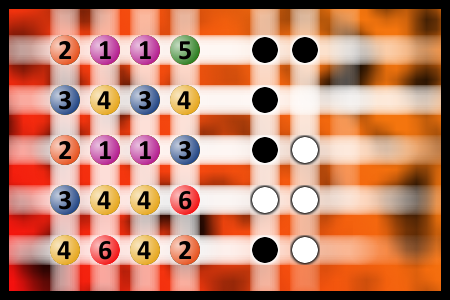
[1181] Find the right combination - The computer chose a secret code (sequence of 4 digits from 1 to 6). Your goal is to find that code. Black circles indicate the number of hits on the right spot. White circles indicate the number of hits on the wrong spot. - #brainteasers #mastermind - Correct Answers: 54 - The first user who solved this task is James Lillard
BRAIN TEASERS
enter your answer and press button OK

Find the right combination

The computer chose a secret code (sequence of 4 digits from 1 to 6). Your goal is to find that code. Black circles indicate the number of hits on the right spot. White circles indicate the number of hits on the wrong spot.
Correct answers: 54
The first user who solved this task is James Lillard.
#brainteasers #mastermind
Register with your Google Account and start collecting points.
Check your ranking on list.

A few short jokes for a mid-week laugh

Doctor: Your body has run out of magnesium.
Me: 0Mg

"Dad, can you tell me what a solar eclipse is?"
No sun.

Dude 1: “Hey bro?”
Dude 2: “Yeah bro?”
Dude 1: “Can you hand me that pamphlet?”
Dude 2: “Brochure”

Sad news at the Nestle factory today when a member of staff was seriously injured when a pallet of chocolate fell more than 50 feet and crushed him underneath... He tried in vain to attract attention,
but every time he shouted "The milky bars are on me"
everyone cheered

What starts with a Y and ends with an X?
Dyslexia

Jokes of the day - Daily updated jokes. New jokes every day.
Follow Brain Teasers on social networks

Brain Teasers

puzzles, riddles, mathematical problems, mastermind, cinemania...

Royal College of Chemistry

In 1846, Prince Albert laid the first stone for the College of Chemistry. It was founded in Jul 1845 for the purpose of instruction in chemistry with a well-appointed laboratory. Although the first British public laboratory appears to have been opened by Thomas Thomson in Glasgow (1817), the College of Chemistry in London provided the first important step for providing students the means for the systematic study of chemistry at moderate expense. The laboratories were designed by August Wilhelm Hofman, who accepted a professorship in 1845 at the instigation of Prince Albert. It became the Royal College of Chemistry in 1853 when it was taken over by the government. Sir Edward Frankland followed Hofman in 1864. In 1907 it was incorporated in the Imperial College of Science and Technology.«
This site uses cookies to store information on your computer. Some are essential to help the site properly. Others give us insight into how the site is used and help us to optimize the user experience. See our privacy policy.