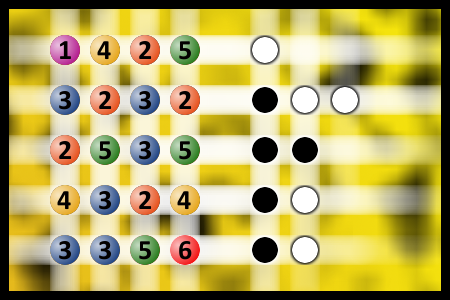
Find the right combination
[1386] Find the right combination - The computer chose a secret code (sequence of 4 digits from 1 to 6). Your goal is to find that code. Black circles indicate the number of hits on the right spot. White circles indicate the number of hits on the wrong spot. - #brainteasers #mastermind - Correct Answers: 52 - The first user who solved this task is James Lillard
BRAIN TEASERS
enter your answer and press button OK

Find the right combination

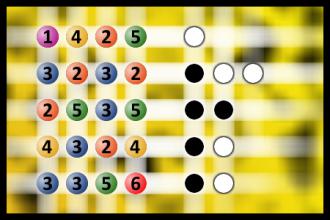
The computer chose a secret code (sequence of 4 digits from 1 to 6). Your goal is to find that code. Black circles indicate the number of hits on the right spot. White circles indicate the number of hits on the wrong spot.
Correct answers: 52
The first user who solved this task is James Lillard.
#brainteasers #mastermind
Register with your Google Account and start collecting points.
Check your ranking on list.

An old man goes to the Wizard ...

An old man goes to the Wizard to ask him if he can remove a "Curse" he has been living with for the last 40 years.
The Wizard says "maybe, but you will have to tell me the exact words that were used to put the curse on you."
The old man says without hesitation "'I now pronounce you man and wife'".
Jokes of the day - Daily updated jokes. New jokes every day.
Follow Brain Teasers on social networks

Brain Teasers

puzzles, riddles, mathematical problems, mastermind, cinemania...

Samuel Williams

Born 23 Apr 1743; died 2 Jan 1817 at age 73.American natural philosopher and clergyman who organized the first expedition of its kind in the U.S. (departing on 9 Oct 1780) to observe a total solar eclipse in Penobscot Bay, Maine, although it was held by the British enemy. The eclipse was very slightly less than being total, and he is believed to be the first to observe the “ Baily's Beads” phenomenon seen along the sun's last sliver. Previously, with John Winthrop (under whom he studied) he travelled to St. John's, Newfoundland (1761) to observer the Transit of Venus. When Wintrop died, Williams succeeded him (1779) as the Hollis Professor of Mathematics and Natural Philosophy at Harvard University. He researched and taught astronomy, meteorology, and magnetism. He resigned in June 1788. He also engaged in state boundary surveys: NY and Mass. (1785-88), and Vermont and Canada (1795).«[Image drawn from a miniature.]
This site uses cookies to store information on your computer. Some are essential to help the site properly. Others give us insight into how the site is used and help us to optimize the user experience. See our privacy policy.