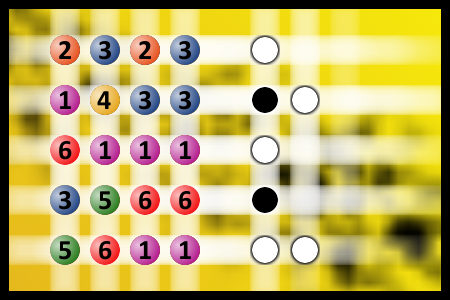
Find the right combination
[1597] Find the right combination - The computer chose a secret code (sequence of 4 digits from 1 to 6). Your goal is to find that code. Black circles indicate the number of hits on the right spot. White circles indicate the number of hits on the wrong spot. - #brainteasers #mastermind - Correct Answers: 62 - The first user who solved this task is James Lillard
BRAIN TEASERS
enter your answer and press button OK

Find the right combination

The computer chose a secret code (sequence of 4 digits from 1 to 6). Your goal is to find that code. Black circles indicate the number of hits on the right spot. White circles indicate the number of hits on the wrong spot.
Correct answers: 62
The first user who solved this task is James Lillard.
#brainteasers #mastermind
Register with your Google Account and start collecting points.
Check your ranking on list.

Under the kilt...

The American tourist stood staring at the highland sentry standing guard outside Edinburgh Castle.

After a few minutes she went up to the sentry and asked 'I've always wanted to find out what's worn under the kilt'.

The sentry replied: 'There is nothing worn, Ma'am, its all in perfect working order'.

Jokes of the day - Daily updated jokes. New jokes every day.
Follow Brain Teasers on social networks

Brain Teasers

puzzles, riddles, mathematical problems, mastermind, cinemania...

Herbert Copeland

Born 21 May 1902; died 15 Oct 1968 at age 66.Herbert Faulkner Copeland was an American biologist who delineated four biological kingdoms, instead of just two for plants and animals. A decade after Darwin's Origin of Species, Ernst Haekel had proposed (1866) adding a kingdom, Protista, for microorganisms, but it wasn't accepted. Copeland further discriminated among the microorganisms in a paper in 1938, splitting them into two kingdoms: Monera and Protista. Copeland identified Monera as organisms without nuclei, and Protista as being largely unicellular, with nuclei. By 1956, he published a book,The Classification of Lower Organisms, still trying “to pursuade the community of biologists” to adopt these four kingdoms. Change came slowly, and continues beyond Copeland's ideas to now five or six. He was the son of botanist Edwin B. Copeland, from whom he learned the principles of classification.«
This site uses cookies to store information on your computer. Some are essential to help the site properly. Others give us insight into how the site is used and help us to optimize the user experience. See our privacy policy.