Find the right combination
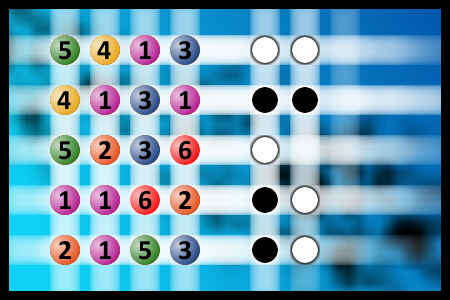
[414] Find the right combination - The computer chose a secret code (sequence of 4 digits from 1 to 6). Your goal is to find that code. Black circles indicate the number of hits on the right spot. White circles indicate the number of hits on the wrong spot. - #brainteasers #mastermind - Correct Answers: 64 - The first user who solved this task is Sanja Šabović
BRAIN TEASERS
enter your answer and press button OK

Find the right combination

The computer chose a secret code (sequence of 4 digits from 1 to 6). Your goal is to find that code. Black circles indicate the number of hits on the right spot. White circles indicate the number of hits on the wrong spot.
Correct answers: 64
The first user who solved this task is Sanja Šabović.
#brainteasers #mastermind
Register with your Google Account and start collecting points.
Check your ranking on list.

Jessi Klein: Backhanded Compliment

Guys have said to me, You know, Jessi, part of what makes you so pretty is you have no idea how pretty you are. And then theyre just like, Enjoy. And Im like, That is not nice. That is like, at best, thats like a backhanded compliment. And at worst, thats just like a forehanded insult because I know that what that sentence really means is, Part of what makes you so pretty is that your self-esteem is so low, its easier for me to f**k you.
Jokes of the day - Daily updated jokes. New jokes every day.
Follow Brain Teasers on social networks

Brain Teasers

puzzles, riddles, mathematical problems, mastermind, cinemania...

Oklahoma meteorite

In 1970, a fireball was visible over a large area of the U.S. midwest. The meteorite that fell was the first to be detected by the Prairie Network operated by the Smithsonian Institution's Astrophysical Observatory since 1964. Its path was photographed by two of the system's 16 cameras funded by a NASA grant. Using these records, scientists calculated the meteorite's impact point. Gunther Schwartz, field manager of the network found the 21.6-lb meteorite six days later within a half-mile of the predicted site, near the rural hamlet Lost City, about 45 miles east of Tulsa, OK. The fast retrieval enabled examination of radioactivity produced by the meteorite's exposure to cosmic rays, looking for clues to how the universe was created.*«[Image: Dr Richard McCrosky of the Smithsonian Astrophysical Laboratory holds the meteorite retrieved by Gunther Schwartz (left).]
This site uses cookies to store information on your computer. Some are essential to help the site properly. Others give us insight into how the site is used and help us to optimize the user experience. See our privacy policy.