Find the right combination
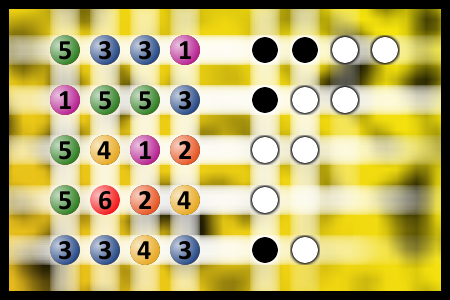
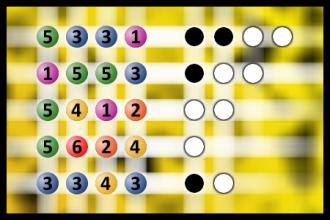
[913] Find the right combination - The computer chose a secret code (sequence of 4 digits from 1 to 6). Your goal is to find that code. Black circles indicate the number of hits on the right spot. White circles indicate the number of hits on the wrong spot. - #brainteasers #mastermind - Correct Answers: 62 - The first user who solved this task is James Lillard
BRAIN TEASERS
enter your answer and press button OK

Find the right combination

The computer chose a secret code (sequence of 4 digits from 1 to 6). Your goal is to find that code. Black circles indicate the number of hits on the right spot. White circles indicate the number of hits on the wrong spot.
Correct answers: 62
The first user who solved this task is James Lillard.
#brainteasers #mastermind
Register with your Google Account and start collecting points.
Check your ranking on list.

A Scottish lad and lass were s...

A Scottish lad and lass were sitting together on a heathery hill in the Highlands. They had been silent for a while, then the lass said, "A penny for your thoughts."
The lad was a bit abashed, but he finally said, "Well, I was thinkin' how nice it would be if ye'd give me a wee bit of a kiss."
So she did so.
But he again lapsed into a pensive mood which lasted long enough for the lass to ask him, "What are ye thinkin' now?"
To which the lad replied: "Well, I was hopin' ye hadn't forgot the penny!"
Jokes of the day - Daily updated jokes. New jokes every day.
Follow Brain Teasers on social networks

Brain Teasers

puzzles, riddles, mathematical problems, mastermind, cinemania...

William Thomas Astbury

Born 25 Feb 1898; died 4 Jun 1961 at age 63. English physical biochemist who was the first to make use of X-ray diffraction patterns to study the structure of nucleic acids (1937). Astbury researched the method under Bragg for seven years, then investigated the structure of wool in both the stretched and unstretched forms. From the difference in the diffraction patterns, he began to try to work ot the structure of protein molecules. His preliminary determination of the structure of nucleic acids were, in fact, wrong - but it gave impetus to Pauling's work with proteins, and to Crick and Watson's study of DNA structure. His work, slowly decoding the nature of molecular structure of virtually the largest organic materials, fibrous and globular proteins, was valuable to both science and industry.
This site uses cookies to store information on your computer. Some are essential to help the site properly. Others give us insight into how the site is used and help us to optimize the user experience. See our privacy policy.