


Rules
Guess the NERDLE in 6 tries. After each try, the color of the tiles will change to show how close your guess is to the solution.
If the tile becomes GREEN, your number or operation is located at correct place. If the tile becomes RED, your number or opeartion exists within the expression, but at different place.
- Each try is a calculation (math expression).
- You can use 0 1 2 3 4 5 6 7 8 9 + - * / or =.
- It must contain one “=”.
- It must only have a number to the right of the “=”, not another calculation.
- Standard order of operations applies, so calculate * and / before + and - eg. 3+2*5=13 not 25!

Joke Of The Day
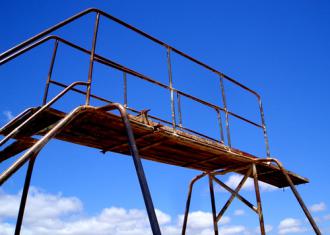
Passing a Mental Exam
Three patients in a mental institution prepare for an examination given by the head psychiatrist. If the patients pass the exam, they will be free to leave the hospital. However, if they fail, the institution will detain them for five years.
The doctor takes the three patients to the top of a diving board looking over an empty swimming pool, and asks the first patient to jump.
The first patient jumps head first into the pool and breaks both arms.
Then the second patient jumps and breaks both legs.
The third patient looks over the side and refuses to jump. "Congratulations! You're a free man. Just tell me why didn't you jump?" asked the doctor.
To which the third patient answered, "Well Doc, I can't swim!"
On This Day
Sir Christopher HintonDied 22 Jun 1983 at age 82 (born 12 May 1901).(Baron of Bankside) English engineer who was a leading figure in the development of the nuclear energy industry in Britain; he supervised the construction of Calder Hall, the world's first large-scale nuclear power station (opened in 1956). He first worked for Imperial Chemical Industries (ICI) where at age 29 he was appointed chief engineer of the Alkali Groups. While at ICI he was selected to start building nuclear power plants. Britain's first four such plants were completed in six years. He played a founding role in fast breeder technology. The decision to build the Dounreay Fast Reactor was made in 1954, which ran successfully for over two decades, until its planned shutdown in 1977, thus demonstrating the safe operation of the concept. |


