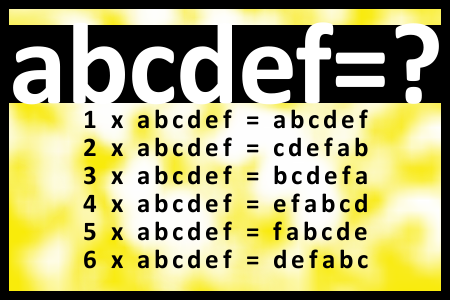
What is abcdef?
[169] What is abcdef? - a != b != c != d !=e != f - #brainteasers #math - Correct Answers: 41 - The first user who solved this task is Sanja Šabović
BRAIN TEASERS
enter your answer and press button OK

What is abcdef?

a != b != c != d !=e != f
Correct answers: 41
The first user who solved this task is Sanja Šabović.
#brainteasers #math
Register with your Google Account and start collecting points.
Check your ranking on list.

Words of Wisdom...

The problem with the gene pool is that there is no lifeguard.

Experience is something you don't get until just after you need it.

A conscience is what hurts when all your other parts feel so good.

For every action, there is an equal and opposite criticism.

To steal ideas from one person is plagiarism; to steal from many is research.

Two wrongs are only the beginning.

Monday is an awful way to spend 1/7th of your life.

The sooner you fall behind, the more time you'll have to catch up.

A clear conscience is usually the sign of a bad memory.

If you must choose between two evils, pick the one you've never tried before.

Love may be blind, but marriage is a real eye-opener.

Borrow money from pessimists, they don't expect it back.

Half the people you know are below average.

Jokes of the day - Daily updated jokes. New jokes every day.
Follow Brain Teasers on social networks

Brain Teasers

puzzles, riddles, mathematical problems, mastermind, cinemania...

Carl Friedrich Wilhelm Ludwig

Died 23 Apr 1895 at age 78 (born 29 Dec 1816). German physiologist and biochemist who was one of the creators of modern physiology. He applied the experimental approach of chemistry and physics to explain the way the body functions. Ludwig investigated the structure of the kidneys and cardiac activity. The kymograph he invented (1847) continuously recorded blood pressure on a rotating drum. He explained blood circulation in terms of conventional forces, repudiating any mysterious "vital force." With his mercurial blood-gas pump (1859) he extracted gases from blood for study. In 1856, he was the first to keep an organ alive after removal from an animal (a frog heart), using perfusion (pumping blood plasma through them.) He was also first to study the nitrogen content of urine as a measure of protein metabolism.«
This site uses cookies to store information on your computer. Some are essential to help the site properly. Others give us insight into how the site is used and help us to optimize the user experience. See our privacy policy.