What a winning combination?
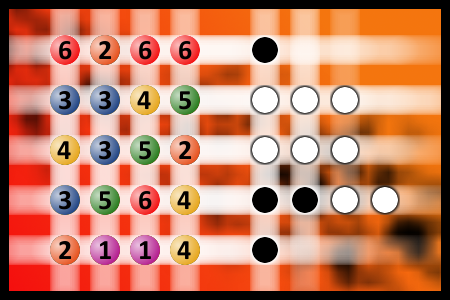
[1045] What a winning combination? - The computer chose a secret code (sequence of 4 digits from 1 to 6). Your goal is to find that code. Black circles indicate the number of hits on the right spot. White circles indicate the number of hits on the wrong spot. - #brainteasers #mastermind - Correct Answers: 65 - The first user who solved this task is James Lillard
BRAIN TEASERS
enter your answer and press button OK

What a winning combination?

The computer chose a secret code (sequence of 4 digits from 1 to 6). Your goal is to find that code. Black circles indicate the number of hits on the right spot. White circles indicate the number of hits on the wrong spot.
Correct answers: 65
The first user who solved this task is James Lillard.
#brainteasers #mastermind
Register with your Google Account and start collecting points.
Check your ranking on list.

Going on vacation

A man is talking to his friend and he says: "I'm about to go on vacation, and I don't know what to do."

His buddy asks: "Why?"

And the man says: "Well, last year's vacation was Hawaii. I came back, and my wife was pregnant. The year before that was the Bahamas. I came back, and my wife was pregnant. The year before that was Paris. I came back and my wife was pregnant again."

His buddy asks: "So what are you going to do differently this year?"

And the guy says: "Well, this year I'm going to bring my wife."

Jokes of the day - Daily updated jokes. New jokes every day.
Follow Brain Teasers on social networks

Brain Teasers

puzzles, riddles, mathematical problems, mastermind, cinemania...

Georges Friedel

Died 11 Dec 1933 at age 68 (born 19 Jul 1865).French crystallographer who formulated basic laws concerning the external morphology and internal structure of crystals. He was the son of Charles Friedel (1832-99), French mineralogist and organic chemist. He recognized, in 1892, that liquid crystals had three types of organisation (mesophases). In 1893, he became professor at the National School of the Mines in Saint-Etienne. After WW I, he moved to the University of Strasbourg. Illness caused his premature retirement in 1930.
This site uses cookies to store information on your computer. Some are essential to help the site properly. Others give us insight into how the site is used and help us to optimize the user experience. See our privacy policy.