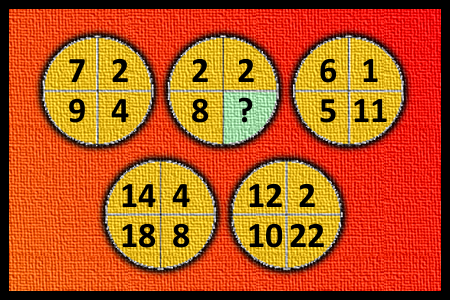
Which number should replace the question mark?
[217] Which number should replace the question mark? - FUNNY MATH: Which number should replace the question mark? - #brainteasers #math #riddles - Correct Answers: 167 - The first user who solved this task is Eric Newton
BRAIN TEASERS
enter your answer and press button OK

Which number should replace the question mark?

FUNNY MATH: Which number should replace the question mark?
Correct answers: 167
The first user who solved this task is Eric Newton.
#brainteasers #math #riddles
Register with your Google Account and start collecting points.
Check your ranking on list.

Where ya from, Sam?

A man lay sprawled across three entire seats in a theater. When the usher came by and noticed this, he whispered to the man, "Sorry, sir, but you're only allowed one seat." The man groaned but didn't budge. The usher became impatient.

"Sir," the usher said, "if you don't get up from there I'm going to have to call the manager."

Again, the man just groaned, which infuriated the usher who turned and marched briskly back up the aisle in search of his manager. In a few moments, both the usher and the manager returned and stood over the man. Together the two of them tried repeatedly to move him, but with no success. Finally, they summoned the police.

The cop surveyed the situation briefly then asked, "All right buddy, what's your name?" "Sam," the man moaned. "Where ya from, Sam?" the cop asked.

And with pain in his voice, Sam replied, "The balcony."

Jokes of the day - Daily updated jokes. New jokes every day.
Follow Brain Teasers on social networks

Brain Teasers

puzzles, riddles, mathematical problems, mastermind, cinemania...

Philip Edward Smith

Died 8 Dec 1970 at age 86 (born 1 Jan 1884).American endocrinologist who demonstrated the importance of the pituitary. Beginning in 1916, often collaborating with his wife, Smith set out to study the embryonic frog pituitary. He painstakingly made the microinstruments needed to operate on the pituitary anlage (bud) of the 4-mm tadpole. In 1926, he fashioned a minute pipette to remove the rat pituitary by suction without damage to the brain. He showed that such “hypophysectomy”resulted in the cessation of growth and atrophy of the other adrenal glands, such as the thyroid, the adrenal cortex, and the reproductive glands. Smith was thus able to study “pure”hypopituitarism and hormone replacement therapy and to publish a paper immediately recognized as classic.
This site uses cookies to store information on your computer. Some are essential to help the site properly. Others give us insight into how the site is used and help us to optimize the user experience. See our privacy policy.