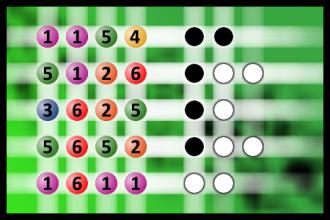
Which is a winning combination of digits?
[1052] Which is a winning combination of digits? - The computer chose a secret code (sequence of 4 digits from 1 to 6). Your goal is to find that code. Black circles indicate the number of hits on the right spot. White circles indicate the number of hits on the wrong spot. - #brainteasers #mastermind - Correct Answers: 47 - The first user who solved this task is James Lillard
BRAIN TEASERS
enter your answer and press button OK

Which is a winning combination of digits?

The computer chose a secret code (sequence of 4 digits from 1 to 6). Your goal is to find that code. Black circles indicate the number of hits on the right spot. White circles indicate the number of hits on the wrong spot.
Correct answers: 47
The first user who solved this task is James Lillard.
#brainteasers #mastermind
Register with your Google Account and start collecting points.
Check your ranking on list.

Fidel Castro and drinking

When he was a young man Fidel Castro went to a Cuban psychic and asked if she could tell anything about him. The old woman looked at Fidel closely and declared, “You should avoid alcohol at all costs.
Because when you are drunk I predict that you will make waves, overthrow governments, and stir up revolution!”
She pointed at him, “So do not, under any circumstances, become inebriated!”
Jokes of the day - Daily updated jokes. New jokes every day.
Follow Brain Teasers on social networks

Brain Teasers

puzzles, riddles, mathematical problems, mastermind, cinemania...

Alexander Meissner

Died 3 Jan 1958 at age 74 (born 14 Sep 1883).Austrian engineer whose work in antenna design, amplification, and detection advanced the development of radio telegraphy. In 1907 he joined the Telefunken Company of Berlin, where he conducted research on radio problems. He improved the design of antennas for transmitting at long wavelengths, devised new vacuum-tube circuits and amplification systems, and developed the heterodyne principle for radio reception. In 1911 Meissner designed the first rotary radio beacon to aid in the navigation of the Zeppelin airships. In 1913 he was the first to amplify high-frequency radio signals by using feedback in a vacuum triode; this principle made it possible to build radio receivers more sensitive than any earlier type.
This site uses cookies to store information on your computer. Some are essential to help the site properly. Others give us insight into how the site is used and help us to optimize the user experience. See our privacy policy.