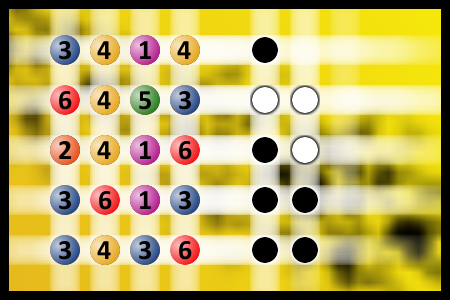
Which is a winning combination of digits?
[1138] Which is a winning combination of digits? - The computer chose a secret code (sequence of 4 digits from 1 to 6). Your goal is to find that code. Black circles indicate the number of hits on the right spot. White circles indicate the number of hits on the wrong spot. - #brainteasers #mastermind - Correct Answers: 54 - The first user who solved this task is James Lillard
BRAIN TEASERS
enter your answer and press button OK

Which is a winning combination of digits?

The computer chose a secret code (sequence of 4 digits from 1 to 6). Your goal is to find that code. Black circles indicate the number of hits on the right spot. White circles indicate the number of hits on the wrong spot.
Correct answers: 54
The first user who solved this task is James Lillard.
#brainteasers #mastermind
Register with your Google Account and start collecting points.
Check your ranking on list.

Valentines's day

A guy walks into a post office one day to see a middle-aged, balding man standing at the counter methodically placing "Love" stamps on bright pink envelopes with hearts all over them.

He then takes out a perfume bottle and starts spraying scent all over them.

His curiosity gets the better of him and he goes up to the balding man and asks him what he's doing.

"I'm sending out 1,000 Valentine's Day cards signed, 'Guess who?'"

"But why?" asks the man.

"I'm a divorce lawyer."

Submitted by Curtis

Edited by Calamjo

Jokes of the day - Daily updated jokes. New jokes every day.
Follow Brain Teasers on social networks

Brain Teasers

puzzles, riddles, mathematical problems, mastermind, cinemania...

Kinetoscope parlor

In 1894, the first Kinetoscope parlor opened in New York with five machines. For 25 cents, customers looked through a peephole to view a short film. A motorized film loop was threaded around a number of rollers within a wooden cabinet. Thomas Edison invented these early motion picture machines to do "for the eye what the phonograph does for the ear." After several years of effort, by 1892, Edison with W.K.L. Dickson, had invented the "kinetograph" - a camera to take motion pictures. Edison then began producing films to exhibit. The machines sold for $250 each, but within a year, competitors entered the market, and public interest declined sharply. By then, however, the era of projected pictures had already dawned.«
This site uses cookies to store information on your computer. Some are essential to help the site properly. Others give us insight into how the site is used and help us to optimize the user experience. See our privacy policy.