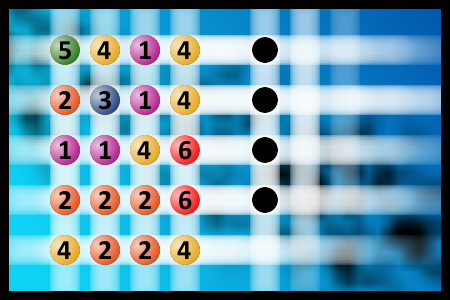
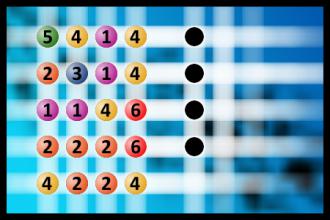
Which is a winning combination of digits?
[1476] Which is a winning combination of digits? - The computer chose a secret code (sequence of 4 digits from 1 to 6). Your goal is to find that code. Black circles indicate the number of hits on the right spot. White circles indicate the number of hits on the wrong spot. - #brainteasers #mastermind - Correct Answers: 86 - The first user who solved this task is James Lillard
BRAIN TEASERS
enter your answer and press button OK

Which is a winning combination of digits?

The computer chose a secret code (sequence of 4 digits from 1 to 6). Your goal is to find that code. Black circles indicate the number of hits on the right spot. White circles indicate the number of hits on the wrong spot.
Correct answers: 86
The first user who solved this task is James Lillard.
#brainteasers #mastermind
Register with your Google Account and start collecting points.
Check your ranking on list.

Nun of Your Business

While shopping in a food store, two nuns happened to pass by the beer, wine, and liquor section. One asked the other if she would like a beer. The second nun answered that, indeed, it would be very nice to have one, but that she would feel uncomfortable purchasing it. The first nun replied that she would handle it without a problem. She picked up a six-pack and took it to the cashier. The cashier was surprised, so the nun said, “This is for washing our hair. ”Without blinking an eye, the cashier reached under the counter and put a package of pretzel sticks in the bag with the beer. “The curlers are on me.”
Jokes of the day - Daily updated jokes. New jokes every day.
Follow Brain Teasers on social networks

Brain Teasers

puzzles, riddles, mathematical problems, mastermind, cinemania...

Edward Troughton

Died 12 Jun 1835 (born Oct 1753).English scientist and instrument maker. Troughton soon established himself as the leading maker of instruments in England. Not only did he make great improvements in the design of existing instruments, but he also invented many new instruments. He began his instrument making career with instruments to aid navigation, for example, he designed the 'pillar' sextant, patented in 1788, the dip sector, the marine barometer and the reflecting circle built in 1796. Other instruments which he designed were for use in surveying. He designed the pyrometer, the mountain barometer and the large surveying theodolites. His famous instruments were astronomical ones. He made the Groombridge Transit Circle in 1805 and a six foot Mural Transit Circle in 1810 which was erected at the Observatory in Greenwich in 1812.
This site uses cookies to store information on your computer. Some are essential to help the site properly. Others give us insight into how the site is used and help us to optimize the user experience. See our privacy policy.