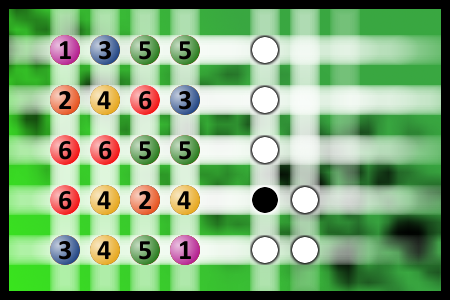
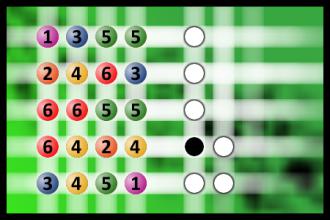
Which is a winning combination of digits?
[184] Which is a winning combination of digits? - The computer chose a secret code (sequence of 4 digits from 1 to 6). Your goal is to find that code. Black circles indicate the number of hits on the right spot. White circles indicate the number of hits on the wrong spot. - #brainteasers #mastermind - Correct Answers: 51 - The first user who solved this task is Sanja Šabović
BRAIN TEASERS
enter your answer and press button OK

Which is a winning combination of digits?

The computer chose a secret code (sequence of 4 digits from 1 to 6). Your goal is to find that code. Black circles indicate the number of hits on the right spot. White circles indicate the number of hits on the wrong spot.
Correct answers: 51
The first user who solved this task is Sanja Šabović.
#brainteasers #mastermind
Register with your Google Account and start collecting points.
Check your ranking on list.

Partial disability

A man was being interviewed for a job. "Were you in the service?" the interviewer asks.

"Yes, I was a Marine," responds the applicant.

"Did you see any active duty?"

"I was in Vietnam for two years and I have a partial disability."

"May I ask what happened?"

"Well, I had a grenade go off between my legs and I lost both testicles."

"You're hired. You can start Monday at 10 a.m."

"When does everyone else start? I don't want any preferential treatment because of my disability."

"Everyone else starts at 7 a.m., but I might as well be honest with you. Nothing gets done between 7 and 10. We just sit around scratching our balls trying to decide what to do first."

Jokes of the day - Daily updated jokes. New jokes every day.
Follow Brain Teasers on social networks

Brain Teasers

puzzles, riddles, mathematical problems, mastermind, cinemania...

Radio fax

In 1905, the radio fax was patented in the U.S. by Cornelius Ehret of Rosemont, Pennsylvania. His device was called "a system for transmitting intelligence." However, faxing did not become a practical mode of communication until the 1920s, and high-speed faxes were not available until the 1940s.
This site uses cookies to store information on your computer. Some are essential to help the site properly. Others give us insight into how the site is used and help us to optimize the user experience. See our privacy policy.