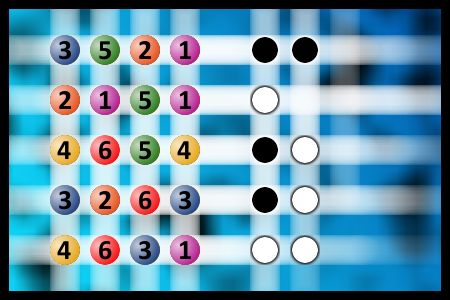
Which is a winning combination of digits?
[640] Which is a winning combination of digits? - The computer chose a secret code (sequence of 4 digits from 1 to 6). Your goal is to find that code. Black circles indicate the number of hits on the right spot. White circles indicate the number of hits on the wrong spot. - #brainteasers #mastermind - Correct Answers: 47 - The first user who solved this task is Sanja Šabović

BRAIN TEASERS
enter your answer and press button OK

Which is a winning combination of digits?

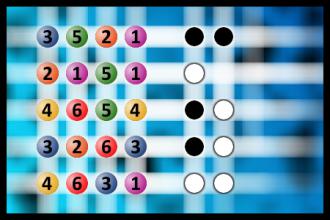
The computer chose a secret code (sequence of 4 digits from 1 to 6). Your goal is to find that code. Black circles indicate the number of hits on the right spot. White circles indicate the number of hits on the wrong spot.
Correct answers: 47
The first user who solved this task is Sanja Šabović.
#brainteasers #mastermind
Register with your Google Account and start collecting points.
Check your ranking on list.

A young boy walks into a barbe...

A young boy walks into a barber shop, and the barber leans in and says to his customer, "This is the dumbest kid in the world. Watch and see."

The barber then places a dollar bill in one hand and two quarters in the other, calling the boy over and asking, "Which one do you want, kid?"

The boy takes the quarters and leaves.

"See what I mean?" the barber says. "He never learns!"

Later, as the customer is leaving, he notices the same boy coming out of an ice cream parlor. "Hey, kid! Can I ask you something? Why did you pick the quarters over the dollar bill?"

The boy, enjoying his ice cream, replies, "Because if I took the dollar, the game would be over!"

Jokes of the day - Daily updated jokes. New jokes every day.
Follow Brain Teasers on social networks

Brain Teasers

puzzles, riddles, mathematical problems, mastermind, cinemania...

William Kingdon Clifford

Died 3 Mar 1879 at age 33 (born 4 May 1845). British philosopher and mathematician who developed the theory of biquaternions (a generalization of the Irish mathematician Sir William Rowan Hamilton's theory of quaternions) and then linked them with more general associative algebras. In 1870, he survived a shipwreck near Sicily while on an expedition to Italy to obtain scientific data from an eclipse. Influenced by the work of Riemann and Lobachevsky, Clifford studied non-euclidean geometry. In 1870 he wrote On the Space Theory of Matter in which he argued that energy and matter are simply different types of curvature of space. In this work he presented ideas which were to form a fundamental role in Einstein's general theory of relativity.
This site uses cookies to store information on your computer. Some are essential to help the site properly. Others give us insight into how the site is used and help us to optimize the user experience. See our privacy policy.