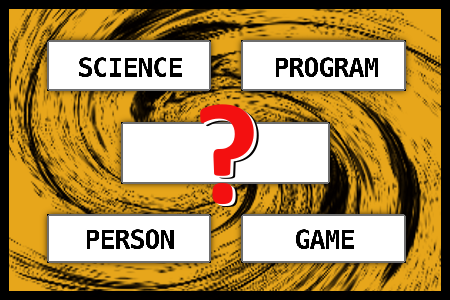
Word Association: SCIENCE, PROGRAM, PERSON, GAME
[232] Word Association: SCIENCE, PROGRAM, PERSON, GAME - Word Association: SCIENCE, PROGRAM, PERSON, GAME - #brainteasers #wordpuzzles #wordassociations #games - Correct Answers: 56 - The first user who solved this task is Eric Newton
BRAIN TEASERS
enter your answer and press button OK

Word Association: SCIENCE, PROGRAM, PERSON, GAME

Word Association: SCIENCE, PROGRAM, PERSON, GAME
Correct answers: 56
The first user who solved this task is Eric Newton.
#brainteasers #wordpuzzles #wordassociations #games
Register with your Google Account and start collecting points.
Check your ranking on list.

A completely inebriated man wa...

A completely inebriated man was stumbling down the street with one foot on the curb and one foot in the gutter.
A cop pulled up and said, "I've got to take you in, pal. You're obviously drunk."
Our wasted friend asked, "Officer, are ya absolutely sure I'm drunk?"
"Yeah, buddy, I'm sure," said the copper. "Let's go."
Breathing a sigh of relief, the wino said, "Thank goodness, I thought I was crippled."
Jokes of the day - Daily updated jokes. New jokes every day.
Follow Brain Teasers on social networks

Brain Teasers

puzzles, riddles, mathematical problems, mastermind, cinemania...

Ultrasound article

In 1958, a seminal article that launched the widespread use of ultrasound in medical diagnosis was published in The Lancet by Ian Donald, an English physician. After a few years developing the experimental use of ultrasound, Donald had applied it to treat patients in his hospital. In the Lancet article, Investigation of Abdominal Masses by Pulsed Ultrasound, he described how he was able to make the life-saving diagnosis of a huge, easily removable, ovarian cyst in a woman who had been diagnosed by others as having inoperable stomach cancer. Donald knew about sonar from his service in WW II, and industrial use of reflected ultrasound waves for flaw detection in materials, and with help from others, he launched its use in medicine.«[Image: a page from the Lancet article.]
This site uses cookies to store information on your computer. Some are essential to help the site properly. Others give us insight into how the site is used and help us to optimize the user experience. See our privacy policy.