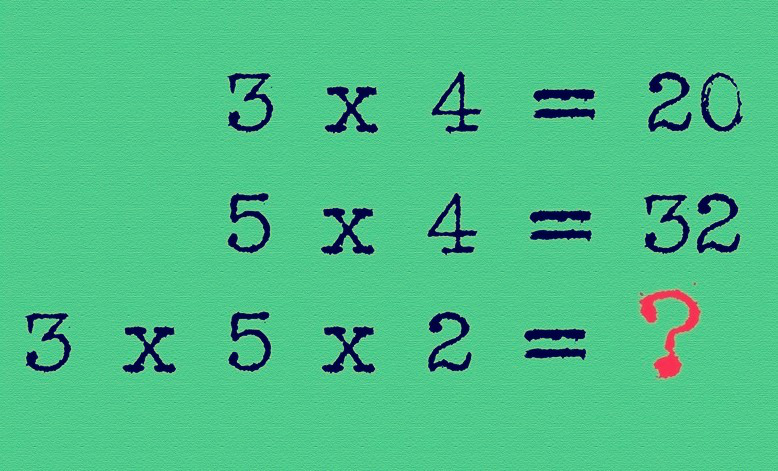
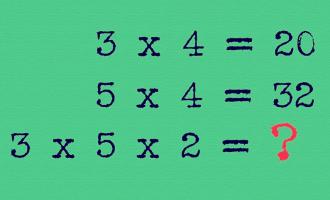
Calculate 3x5x2
[5022] Calculate 3x5x2 - If 3x4=20 and 5x4=32 then 3x5x2=? - #brainteasers #math #riddles - Correct Answers: 67 - The first user who solved this task is Djordje Timotijevic
BRAIN TEASERS
enter your answer and press button OK

Calculate 3x5x2

If 3x4=20 and 5x4=32 then 3x5x2=?
Correct answers: 67
The first user who solved this task is Djordje Timotijevic.
#brainteasers #math #riddles
Register with your Google Account and start collecting points.
Check your ranking on list.

Upon reaching 65, old Tom deci...

Upon reaching 65, old Tom decided to retire. His wife suggested he go and do something to occupy his time, like join a club or get a hobby
Old Tom obliged and went out for a couple of hours. When he got home his wife asked about his day and he replied, "Oh, I joined a parachute club."
"What? Are you nuts? You're 65 years old and you're going to start jumping out of airplanes?"
"Yeah, look I even got a membership card."
"Old man, you need glasses! This is a membership in a Prostitute Club, not a Parachute Club!"
"Oh, great! Now what am I going to do? I signed up for 5 jumps a week!"
Jokes of the day - Daily updated jokes. New jokes every day.
Follow Brain Teasers on social networks

Brain Teasers

puzzles, riddles, mathematical problems, mastermind, cinemania...

Jacobus Cornelius Kapteyn

Born 19 Jan 1851; died 18 Jun 1922 at age 71.Dutch astronomer who used photography and statistical methods in determining the motions and spatial distribution of stars. Such work was the first major step after the works of William and John Herschel. He tried to solve the questions of space density of stars as a function of distance from the sun, and the distribution of starts according to brightness per unit volume. Some of his results had lasting value, but some were superceded because he had failed to account for the interstellar absorption. In studies using proper motion to determine stellar distances, he discovered stellar motions are not random, as previously thought, but that stars move in two "star streams" (1904). He introduced absolute magnitude and colour index as standard concepts.
This site uses cookies to store information on your computer. Some are essential to help the site properly. Others give us insight into how the site is used and help us to optimize the user experience. See our privacy policy.