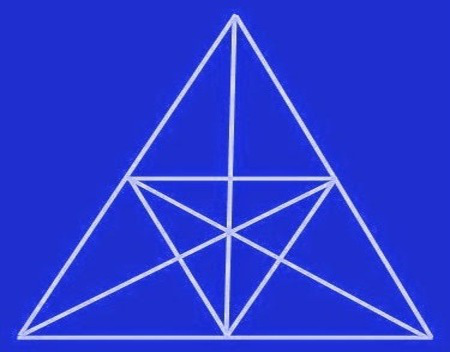
Can you find out the number ...
[1881] Can you find out the number ... - Can you find out the number of triangles in the picture given? - #brainteasers #math #riddles - Correct Answers: 101 - The first user who solved this task is Djordje Timotijevic
BRAIN TEASERS
enter your answer and press button OK

Can you find out the number ...

Can you find out the number of triangles in the picture given?
Correct answers: 101
The first user who solved this task is Djordje Timotijevic.
#brainteasers #math #riddles
Register with your Google Account and start collecting points.
Check your ranking on list.

8 short jokes for good start of the week

We all know where the Big Apple is but does anyone know where the ...
Minneapolis?

I ran out of toilet paper so I had to start using old newspapers ...
The Times are rough

Sink or swim?
Sod it, I'm going in the pool. The dishes can wait!

My friend asked me to name two things that hold water.
"Well, Dam."

I think it is a good idea to wear two different deodorants, one under each armpit
But that's just my two scents

So this kid comes home from school in panic and says Dad, they are all picking on me…are we pyromaniacs?
The dad looks down sadly and says. We arson.

4 asked 5 out but got rejected ...
Cause it was 2 squared.

My wife told me to stop counting.
But I didn't one two.

Jokes of the day - Daily updated jokes. New jokes every day.
Follow Brain Teasers on social networks

Brain Teasers

puzzles, riddles, mathematical problems, mastermind, cinemania...

George Ledyard Stebbins

Born 6 Jan 1906; died 19 Jan 2000 at age 94.American geneticist who was one of the leading evolutionary biologists. Stebbins is considered one of the "architects" of the modern evolutionary synthesis of the 1930-40s (with Dobzhansky, animal systematist Ernst Mayr, and paleontologist George Gaylord Simpson ) Together, their work was a synthesis of research in cytology, genetics, systematics, paleontology. Stebbins created a modern framework for the study of plant evolution. From the 1940s, he artificially created fertile hybrids having more than twice the basic number of chromosomes (and was the first scientist to do so). This technique had value in both taxonomy and plant breeding.
This site uses cookies to store information on your computer. Some are essential to help the site properly. Others give us insight into how the site is used and help us to optimize the user experience. See our privacy policy.