Can you find the area...
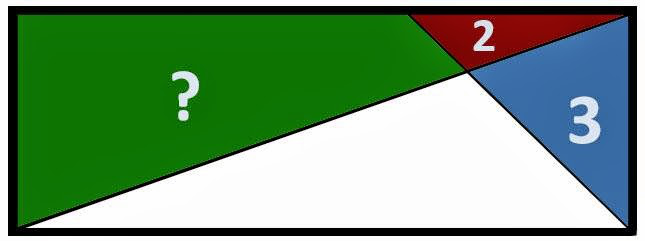
[1891] Can you find the area... - There is a figure below (a rectangle). You can see different colors depicting different regions of the figure. The labels on the top of a region defines the area of that region. Can you find the area of the green shaded region labelled with a question mark? - #brainteasers #math #riddles - Correct Answers: 104 - The first user who solved this task is Neelima Subrahmanyam
BRAIN TEASERS
enter your answer and press button OK

Can you find the area...

There is a figure below (a rectangle). You can see different colors depicting different regions of the figure. The labels on the top of a region defines the area of that region. Can you find the area of the green shaded region labelled with a question mark?
Correct answers: 104
The first user who solved this task is Neelima Subrahmanyam.
#brainteasers #math #riddles
Register with your Google Account and start collecting points.
Check your ranking on list.

After spending a night at a ho...

After spending a night at a hotel with a prostitute, the politician took $300 out of his wallet and placed it on the dressing table.

"Thanks," she said. "But I only charge $20."

"Twenty bucks for the entire night?" the amazed politician replied. "You can't make a living on that."

"Oh, don't worry," the whore replied. "I do a little blackmail on the side!"
Jokes of the day - Daily updated jokes. New jokes every day.
Follow Brain Teasers on social networks

Brain Teasers

puzzles, riddles, mathematical problems, mastermind, cinemania...

Max Schultze

Died 16 Jan 1874 at age 48 (born 25 Mar 1825).German zoologist and cytologist, known especially for his researches in microscopic anatomy. He altered the conception of the cell, emphasizing not the membrane, but the living mass of protoplasm with a nucleus (1861). He pointed out that some cells, for example those of the embryo, do not have bounding membranes. He recognized the protoplasm, with its nucleus, as the fundamental substance found in both plants and animals. Schultze also studied protozoa, and demonstrated minute nerve endings in the ear (1858), nose (1863), and retina (1866). He was an outstanding histologist, introducing several new techniques in histology, including the use of osmic acid for staining fine details of cells. His sudden death in 1874 was caused by a perforated ulcer.
This site uses cookies to store information on your computer. Some are essential to help the site properly. Others give us insight into how the site is used and help us to optimize the user experience. See our privacy policy.