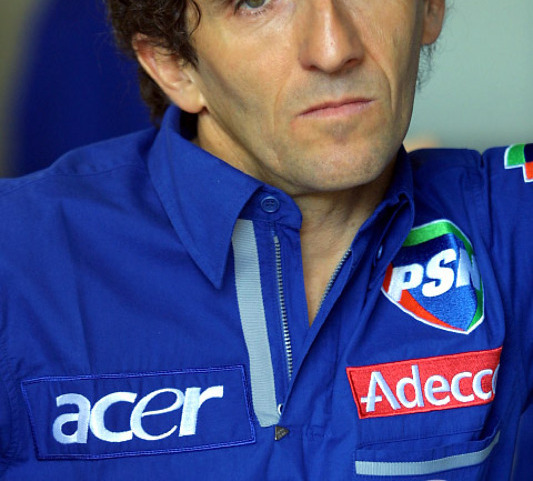
Can you name the athletes by the picture?
[3718] Can you name the athletes by the picture? - Can you name the athletes by the picture? - #brainteasers #riddles #sport - Correct Answers: 20 - The first user who solved this task is On On Lunarbasil
BRAIN TEASERS
enter your answer and press button OK

Can you name the athletes by the picture?

Can you name the athletes by the picture?
Correct answers: 20
The first user who solved this task is On On Lunarbasil.
#brainteasers #riddles #sport
Register with your Google Account and start collecting points.
Check your ranking on list.

Bert always wanted a pair of a...

Bert always wanted a pair of authentic cowboy boots, so, seeing some on sale, he bought a pair and wore them home.
Walking proudly, he sauntered in to the kitchen and said to his wife, Margaret, "Notice anything different about me?"
Margaret looked him over, "Nope."
Frustrated, Bert stormed off in to the bedroom, undressed and walked back in to the kitchen completely naked except for the boots.
Again he asked Margaret, a little louder this time, "Notice anything different NOW?"
Margaret looked up and said in her best deadpan, "Bert. What's different? It's hanging down today, it was hanging down yesterday, and it will be hanging down again tomorrow."
Furious, Bert yelled, "And do you know why it's hanging down?"
"Nope. Not a clue," she replied.
"It's hanging down, because it's looking at my new boots!"
And without missing a beat Margaret replied, "Shoulda bought a new hat, Bert."
Jokes of the day - Daily updated jokes. New jokes every day.
Follow Brain Teasers on social networks

Brain Teasers

puzzles, riddles, mathematical problems, mastermind, cinemania...

John Chipman

Born 25 Apr 1897; died 14 May 1983 at age 86.American physical chemist and metallurgist who researched the role of oxygen in iron and steelmaking. Applying the theories of physical chemistry, he examined the reactions between slag and liquid iron and advanced the techniques of pig iron and steel production. From his work in the early 1930s at the University of Michigan, he began to establish an international reputation for his research on steel. He became a professor of process metallury at M.I.T. in 1937, and was the department head from 1946 until retirement in 1962. During WW II he took a leave of absence from 1943, to work for the Manhattan Project as chief of its metallurgy section, where he found a method to convert powdered unranium into soliod castings, thus providing researchers with a reliable alternate supply of castings when solid uranium was scarce.«
This site uses cookies to store information on your computer. Some are essential to help the site properly. Others give us insight into how the site is used and help us to optimize the user experience. See our privacy policy.