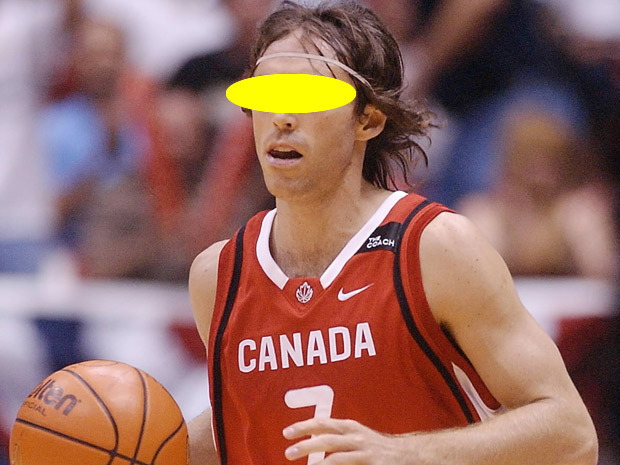
Can you name the athletes by the picture?
[4473] Can you name the athletes by the picture? - Can you name the athletes by the picture? - #brainteasers #riddles #sport - Correct Answers: 55 - The first user who solved this task is Djordje Timotijevic
BRAIN TEASERS
enter your answer and press button OK

Can you name the athletes by the picture?

Can you name the athletes by the picture?
Correct answers: 55
The first user who solved this task is Djordje Timotijevic.
#brainteasers #riddles #sport
Register with your Google Account and start collecting points.
Check your ranking on list.

A sister and brother are talki...

A sister and brother are talking to each other when the little boy gets up and walks over to his Grandpa and says, "Grandpa, please make a frog noise."
The Grandpa says, "No."
The little boy goes on, "Please .. please make a frog noise."
The Grandpa says, "No, now go play."
The little boy then says to his sister, "Go tell Grandpa to make a frog noise."
So the little girl goes to her Grandpa and says, "Please make a frog noise."
The Grandpa says, "I just told your brother 'no' and I'm telling you 'no'." The little girl says, "Please .. please Grandpa make a frog noise." The Grandpa says, "Why do you want me to make a frog noise?"
The little girl replied, "Because mommy said when you croak we can go to Disney World!"
Jokes of the day - Daily updated jokes. New jokes every day.
Follow Brain Teasers on social networks

Brain Teasers

puzzles, riddles, mathematical problems, mastermind, cinemania...

John Dollond

Born 10 Jun 1706; died 30 Nov 1761 at age 55.English optical instrument maker of optical and astronomical instruments who developed (1758) and patented an achromatic (non- colour- distorting) refracting telescope and a practical heliometer, a telescope used to measure the Sun's diameter and the angles between celestial bodies. In the 1730's, Chester More Hall, an attorney with an interest in telescopes, first discovered that flint glass appeared to have a greater color dispersion than crown glass did at the same magnifications. Hall reasoned that if he cemented the concave face of a flint glass lens to the convex face of a crown glass lens, he could remove the dispersion properties (and thus, chromatic aberration) from both lenses simultaneously. Dollond learned of the technique in the 1750's and developed it.
This site uses cookies to store information on your computer. Some are essential to help the site properly. Others give us insight into how the site is used and help us to optimize the user experience. See our privacy policy.