

Hunting jokes
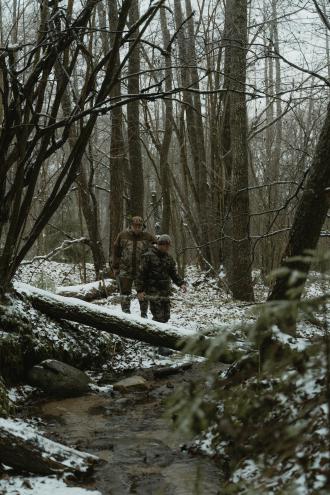
Two hunters are lost in the woods.
After wandering around for a couple hours they decide to weigh their options, one says:
"I heard if you shoot in the air someone will hear and come to your rescue".
So they fire a few times in the air and wait, nothing happens so they try again a couple more times, after a few hours of this they're starting to get worried
and one says: "I hope we get help soon",
To which the other responds, "I know right, I am almost out of arrows"!
*************
"If you're planning to go to the forest, always remember to pack a radio, a flare and a pack of cards.
If you get lost, you can try to use the radio to call someone.
If you run out of batteries, you can shot the flare up into the air...
The cards? Well, if the radio doesn't work and the flare gets wet, you sit down and play solitary.
Sooner than later
someone will tap you in the shoulder to ask you
why don't you move the queen of hearts to the king of clubs"
*************
Two hunters are out in the woods when one of them collapses.
He's not breathing and his eyes are glazed, so his friend calls 911.
"My friend is dead! What should I do?"
The operator replies, "Calm down, sir.
I can help.
First make sure that he's dead."
There's a silence, then a loud bang.
Back on the phone, the guy says,
"OK, now what?"
*************
Two inexperienced hunters are out in the woods, and after a while they come upon some tracks.
"These are bear tracks!" the first hunter exclaims.
"No, idiot, they're deer tracks!" the second one retorts.
"No, moron ..."
And they go on like this for hours, until a train hits them.