
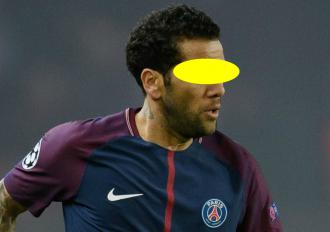
Can you name the athletes by the picture?
[5816] Can you name the athletes by the picture? - Can you name the athletes by the picture? - #brainteasers #riddles #sport - Correct Answers: 20 - The first user who solved this task is Alfa Omega
BRAIN TEASERS
enter your answer and press button OK

Can you name the athletes by the picture?

Can you name the athletes by the picture?
Correct answers: 20
The first user who solved this task is Alfa Omega.
#brainteasers #riddles #sport
Register with your Google Account and start collecting points.
Check your ranking on list.

A sister and brother are talki...

A sister and brother are talking to each other when the little boy gets up and walks over to his Grandpa and says, "Grandpa, please make a frog noise."
The Grandpa says, "No."
The little boy goes on, "Please .. please make a frog noise."
The Grandpa says, "No, now go play."
The little boy then says to his sister, "Go tell Grandpa to make a frog noise."
So the little girl goes to her Grandpa and says, "Please make a frog noise."
The Grandpa says, "I just told your brother 'no' and I'm telling you 'no'." The little girl says, "Please .. please Grandpa make a frog noise." The Grandpa says, "Why do you want me to make a frog noise?"
The little girl replied, "Because mommy said when you croak we can go to Disney World!"
Jokes of the day - Daily updated jokes. New jokes every day.
Follow Brain Teasers on social networks

Brain Teasers

puzzles, riddles, mathematical problems, mastermind, cinemania...

Harold Stephen Black

Died 11 Dec 1983 at age 85 (born 14 Apr 1898).American electrical engineer who discovered and developed the negative-feedback principle, in which amplification output is fed back into the input, thus producing nearly distortionless and steady amplification. In 1921, Black joined the forerunner of Bell Labs, in New York City, working on elimination of distortion. After six years of persistence, Black conceived his negative feedback amplifier in a flash commuting to work aboard the ferry. Basically, the concept involved feeding systems output back to the input as a method of system control. The principle has found widespread applications in electronics, including industrial, military, and consumer electronics, weaponry, analog computers, and such biomechanical devices as pacemakers.
This site uses cookies to store information on your computer. Some are essential to help the site properly. Others give us insight into how the site is used and help us to optimize the user experience. See our privacy policy.