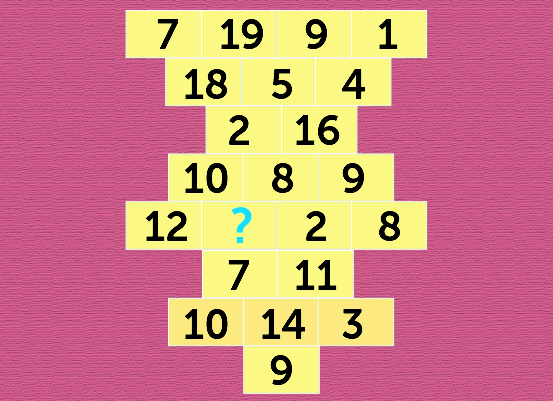
What is the missing number?
[5817] What is the missing number? - What is the missing number? - #brainteasers #math #riddles - Correct Answers: 59 - The first user who solved this task is Alfa Omega
BRAIN TEASERS
enter your answer and press button OK

What is the missing number?

What is the missing number?
Correct answers: 59
The first user who solved this task is Alfa Omega.
#brainteasers #math #riddles
Register with your Google Account and start collecting points.
Check your ranking on list.

The new minister's wife had a ...

The new minister's wife had a baby. The minister appealed to the congregation for a salary increase to cover the addition to the family.The congregation agreed that it was only fair, and approved it.
When the next child arrived, the minister appealed again and the congregation approved again.
Several years and five children later, the congregation was a bit upset over the increasing expense. This turned into a rather loud meeting one night with the minister. Finally, the minister stood and shouted out,"Having children is an act of God!!"
An older man in the back stood and shouted back, "Rain and snow are acts of God, too, and we wear rubbers for them."
Jokes of the day - Daily updated jokes. New jokes every day.
Follow Brain Teasers on social networks

Brain Teasers

puzzles, riddles, mathematical problems, mastermind, cinemania...

Philipp Lenard

Died 20 May 1947 at age 84 (born 7 Jun 1862). Philipp Eduard Anton von Lenard was a Hungarian-German physicist who received the 1905 Nobel Prize for Physics for his research on cathode rays. He discovered they could leave a cathode ray tube, penetrate thin metal sheets, and travel a short distance in the air, which would become conducting.. In 1902, he observed that a free electron (as in a cathode ray) must have at least a certain energy to ionize a gas by knocking a bound electron out of an atom. His estimate of the required ionization energy for hydrogen was remarkably accurate. Also in 1902, he showed that the photoelectric effect produces the same electrons found in cathode rays, that the photoelectrons are not merely dislodged from the metal surface but ejected with a certain amount of energy.
This site uses cookies to store information on your computer. Some are essential to help the site properly. Others give us insight into how the site is used and help us to optimize the user experience. See our privacy policy.