Chess Knight Move
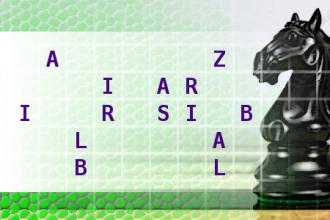
[1662] Chess Knight Move - Find the country and its capital city, using the move of a chess knight. First letter is B. Length of words in solution: 6,8. - #brainteasers #wordpuzzles #chessknightmove - Correct Answers: 70 - The first user who solved this task is Djordje Timotijevic
BRAIN TEASERS
enter your answer and press button OK

Chess Knight Move

Find the country and its capital city, using the move of a chess knight. First letter is B. Length of words in solution: 6,8.
Correct answers: 70
The first user who solved this task is Djordje Timotijevic.
#brainteasers #wordpuzzles #chessknightmove
Register with your Google Account and start collecting points.
Check your ranking on list.

Skin canoes

Three men are found in the wilderness by civilized cannibals. The men are led to a gravesite next to the water. The chief says, 'We will kill you as a coward, or we will let you die honarable deaths for your homelands. You choose the weapon. Either way, your skins will be used to make our canoes.'

The first man, a soldier at heart, asks for a handgun. With this, he recites the Pledge and shoots himself. He is carried off. The next man asks for a sword. A warrior at heart, he uses a Japanese katana to commit seppuku as a Japanese man.

The last man asks for a fork.

'A fork? asks the chief?'

But it's his dying wish, so they hand him the fork. He stabs himself repeatedly in the chest, and yells, 'I HOPE YOUR CANOE SINKS!!'

Jokes of the day - Daily updated jokes. New jokes every day.
Follow Brain Teasers on social networks

Brain Teasers

puzzles, riddles, mathematical problems, mastermind, cinemania...

Marie Curie's second Nobel Prize

In 1911, at Stockholm, Sweden, Marie Curie became the first person to be awarded a second Nobel prize. She had isolated radium by electrolyzing molten radium chloride. At the negative electrode the radium formed an amalgam with mercury. Heating the amalgam in a silica tube filled with nitrogen at low pressure boiled away the mercury, leaving pure white deposits of radium. This second prize was for her individual achievements in Chemistry, whereas her first prize (1903) was a collaborative effort with her husband, Pierre Curie, and Henri Becquerel in Physics for her contributions in the discovery of radium and polonium.
This site uses cookies to store information on your computer. Some are essential to help the site properly. Others give us insight into how the site is used and help us to optimize the user experience. See our privacy policy.