Chess Knight Move
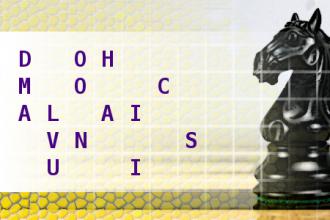
[3903] Chess Knight Move - Find the country and its capital city, using the move of a chess knight. First letter is M. Length of words in solution: 7,8. - #brainteasers #wordpuzzles #chessknightmove - Correct Answers: 33 - The first user who solved this task is Manguexa Wagle
BRAIN TEASERS
enter your answer and press button OK

Chess Knight Move

Find the country and its capital city, using the move of a chess knight. First letter is M. Length of words in solution: 7,8.
Correct answers: 33
The first user who solved this task is Manguexa Wagle.
#brainteasers #wordpuzzles #chessknightmove
Register with your Google Account and start collecting points.
Check your ranking on list.

Just Checkup

A naked woman is bouncing on her bed singing. Her husband walks into the bedroom and sees her. He watches her a while then says, "You look ridiculous! What on earth do you think you're doing?"
She says, "I just got my checkup and my doctor says I have the breasts of an eighteen year old." She starts laughing and jumping again. He says, "Yeah, right. And what did he say about your 45-year-old ass?"
"Your name never came up, " she replied.
Jokes of the day - Daily updated jokes. New jokes every day.
Follow Brain Teasers on social networks

Brain Teasers

puzzles, riddles, mathematical problems, mastermind, cinemania...

Clemens Alexander Winkler

Born 26 Dec 1838; died 8 Oct 1904 at age 65. German chemist who discovered the element germanium (1886). He had a background in managing a cobalt glassworks and then on the faculty of the Freiberg School of Mining. Early in his career, he developed new techniques for industrial gas analysis and developed the Winkler gas burette. When, having been asked by the Freiberg Academy of Mining to analyze the mineral argyrodite (a silver sulphide ore), he found that all the known elements it contained amounted to only 93% of its weight. After spending four months tracking down and isolating the remaining 7%, he found the new element he called germanium, for Germany. This turned out to be the third of the elements (eka-silicon) predicted by Dmitry I. Mendeleyev in 1871.«
This site uses cookies to store information on your computer. Some are essential to help the site properly. Others give us insight into how the site is used and help us to optimize the user experience. See our privacy policy.