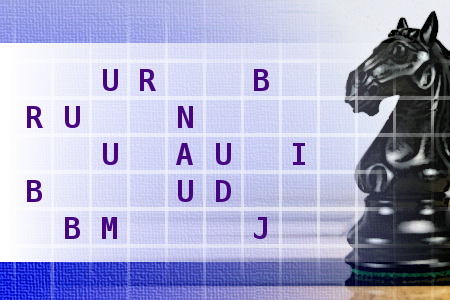
Chess Knight Move
[4236] Chess Knight Move - Find the country and its capital city, using the move of a chess knight. First letter is B. Length of words in solution: 7,9. - #brainteasers #wordpuzzles #chessknightmove - Correct Answers: 31 - The first user who solved this task is Manguexa Wagle
BRAIN TEASERS
enter your answer and press button OK

Chess Knight Move

Find the country and its capital city, using the move of a chess knight. First letter is B. Length of words in solution: 7,9.
Correct answers: 31
The first user who solved this task is Manguexa Wagle.
#brainteasers #wordpuzzles #chessknightmove
Register with your Google Account and start collecting points.
Check your ranking on list.

Late for Work

Tom had this problem of getting up late in the morning and was always late for work. His boss was mad at him and threatened to fire him if he didn't do something about it. So Tom went to his doctor who gave him a pill and told him to take it before he went to bed.
Tom slept well and in fact beat the alarm in the morning. He had a leisurely breakfast and drove cheerfully to work. "Boss," he said, "The pill actually worked!"
"That's all fine" said the boss. "But where were you yesterday?"

Jokes of the day - Daily updated jokes. New jokes every day.
Follow Brain Teasers on social networks

Brain Teasers

puzzles, riddles, mathematical problems, mastermind, cinemania...

Jean-Robert Argand

Born 18 Jul 1768; died 13 Aug 1822 at age 54.Swiss accountant and mathematician who was one of the earliest to use complex numbers, which he applied to show that all algebraic equations have roots. His name is associated with the Argand diagram, a geometrical representation of complex numbers as points in a Cartesian plane, with the real portion of the number on the x axis and the imaginary part on the y axis. He self-published this concept in an anonymous monograph (1806). Though talented in mathematics, he remained an amateur; his livelihood was asan accountant and bookkeeper. Although Argand's name became associated with this idea, the geometrical interpretation of complex numbers appeared earliest in work by Caspar Wessel (1787), first presented on 10 Mar 1797 to a the Royal Danish Academy of Sciences and published in 1799.«
This site uses cookies to store information on your computer. Some are essential to help the site properly. Others give us insight into how the site is used and help us to optimize the user experience. See our privacy policy.