Find the right combination
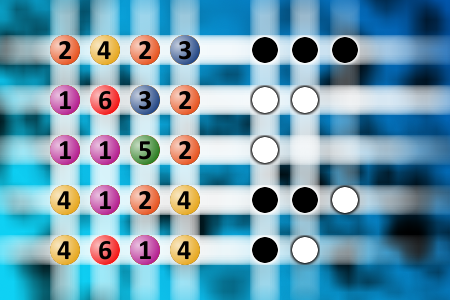
[4235] Find the right combination - The computer chose a secret code (sequence of 4 digits from 1 to 6). Your goal is to find that code. Black circles indicate the number of hits on the right spot. White circles indicate the number of hits on the wrong spot. - #brainteasers #mastermind - Correct Answers: 45 - The first user who solved this task is Thinh Ddh
BRAIN TEASERS
enter your answer and press button OK

Find the right combination

The computer chose a secret code (sequence of 4 digits from 1 to 6). Your goal is to find that code. Black circles indicate the number of hits on the right spot. White circles indicate the number of hits on the wrong spot.
Correct answers: 45
The first user who solved this task is Thinh Ddh.
#brainteasers #mastermind
Register with your Google Account and start collecting points.
Check your ranking on list.

What hapiness is

A man doesn't know what hapiness is until he's married.

By then it's too late.

Frank Skinner (January 28 1957-)

Picture: Reuters

Jokes of the day - Daily updated jokes. New jokes every day.
Follow Brain Teasers on social networks

Brain Teasers

puzzles, riddles, mathematical problems, mastermind, cinemania...

Bananas

In 1633, an unripe bunch of bananas was given to apothcary Thomas Johnson by John Argent, President of the College of Physicians (who received it from a merchant just returned with it from the Bahamas). Johnson hung it at his shop in Snow Hill, London, where it ripened about the beginning of May, and lasted until June. Being the first bananas seen in Britian, the display caused a sensation. Johnson was a field botanist, and he recorded the date in his 1636 edition revising John Gerard's 1597 Herball. The pulp, he wrote, was as soft and tender, and ate somewhate like a musk-melon. He described the leaves as being “of bigness sufficient to wrap a child of two yeeres old”. It was not until 1884, though, that bananas were regularly imported, from the Canary Islands into Britain by Elder Dempster and Co.*[Image: the 'Plantaine fruit', in Thomas Johnson's 1633 edition of Gerard's Herball.]
This site uses cookies to store information on your computer. Some are essential to help the site properly. Others give us insight into how the site is used and help us to optimize the user experience. See our privacy policy.