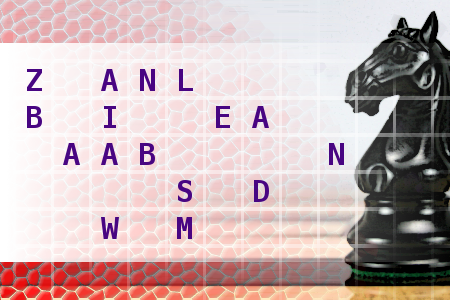
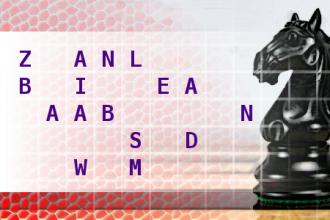
Chess Knight Move
[4270] Chess Knight Move - Find the country and its capital city, using the move of a chess knight. First letter is S. Length of words in solution: 9,7. - #brainteasers #wordpuzzles #chessknightmove - Correct Answers: 24 - The first user who solved this task is Manguexa Wagle
BRAIN TEASERS
enter your answer and press button OK

Chess Knight Move

Find the country and its capital city, using the move of a chess knight. First letter is S. Length of words in solution: 9,7.
Correct answers: 24
The first user who solved this task is Manguexa Wagle.
#brainteasers #wordpuzzles #chessknightmove
Register with your Google Account and start collecting points.
Check your ranking on list.

The firemen finally get a huge...

The firemen finally get a huge fire under control, and Chief Brown has all of his men accounted for except Olson and Rosolino. After a few minutes' search, the chief looks down an alley, and there's Rosolino, leaning over a trash can. His pants are down to his ankles, and Olson is banging away from behind.
Chief Brown says, "What the hell is going on?"
Olson says, "Rosolino passed out from smoke inhalation."
The chief says, "Smoke inhalation? You're supposed to give him mouth-to-mouth resuscitation!"
Olson says, "I did, Chief, but then one thing led to another..."
Jokes of the day - Daily updated jokes. New jokes every day.
Follow Brain Teasers on social networks

Brain Teasers

puzzles, riddles, mathematical problems, mastermind, cinemania...

Johannes Hevelius

Born 28 Jan 1611; died 28 Jan 1687 at age 76.German astronomer, who studying in Leiden and established his own observatory on the rooftops of several houses. From four years' telescopic study of the Moon, using telescopes of long focal power, Hevelius compiled Selenographia ("Pictures of the Moon", 1647), an atlas of the Moon with some of the earliest detailed maps. A few of his names for lunar mountains (e.g., the Alps) are still in use, and a lunar crater is named for him. Hevelius is today best remembered for his use of "aerial" telescopes of enormous focal length and his rejection of telescopic sights for stellar observation and positional measurement. He catalogued 1564 stars in Prodromus Astronomiae (1690), discovered four comets, and was one of the first to observe the transit of Mercury. He died on his birthday.
This site uses cookies to store information on your computer. Some are essential to help the site properly. Others give us insight into how the site is used and help us to optimize the user experience. See our privacy policy.