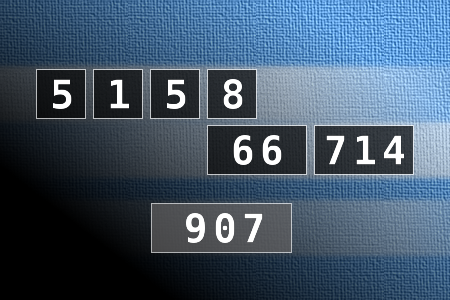
Calculate the number 907
[4269] Calculate the number 907 - NUMBERMANIA: Calculate the number 907 using numbers [5, 1, 5, 8, 66, 714] and basic arithmetic operations (+, -, *, /). Each of the numbers can be used only once. - #brainteasers #math #numbermania - Correct Answers: 20 - The first user who solved this task is Thinh Ddh
BRAIN TEASERS
enter your answer and press button OK

Calculate the number 907

NUMBERMANIA: Calculate the number 907 using numbers [5, 1, 5, 8, 66, 714] and basic arithmetic operations (+, -, *, /). Each of the numbers can be used only once.
Correct answers: 20
The first user who solved this task is Thinh Ddh.
#brainteasers #math #numbermania
Register with your Google Account and start collecting points.
Check your ranking on list.

The recital

A soldier stationed in the South Pacific wrote to his wife in the States to please send him a harmonica to occupy his free time and keep his mind off of the local women. The wife complied and sent the best one she could find, along with several dozen lesson & music books.

Rotated back home, he rushed to their home and thru the front door. "Oh darling" he gushed, "Come here... let me look at you... let me hold you ! Let's have a fine dinner out, then make love all night. I've missed your lovin' so much !" The wife, keeping her distance, said, "All in good time lover. First, let's hear you play that harmonica."

Jokes of the day - Daily updated jokes. New jokes every day.
Follow Brain Teasers on social networks

Brain Teasers

puzzles, riddles, mathematical problems, mastermind, cinemania...

Sir Fred Hoyle

Born 24 Jun 1915; died 20 Aug 2001 at age 86. English astronomer and mathematician who is best known as the foremost proponent and defender of the steady-state theory of the universe. This theory holds both that the universe is expanding and that matter is being continuously created to keep the mean density of matter in space constant. He became Britain's best-known astronomer in 1950 with his broadcast lectures on The Nature of the Universe, and he recalled derisively coining the term “Big Bang” in the last of those talks. Although over time, belief in a “steady state” universe as Hoyle had proposed was shared by fewer and fewer scientists because of new discoveries, Hoyle never accepted the now most popular “Big Bang” theory for the origin of the universe.
This site uses cookies to store information on your computer. Some are essential to help the site properly. Others give us insight into how the site is used and help us to optimize the user experience. See our privacy policy.