Chess Knight Move
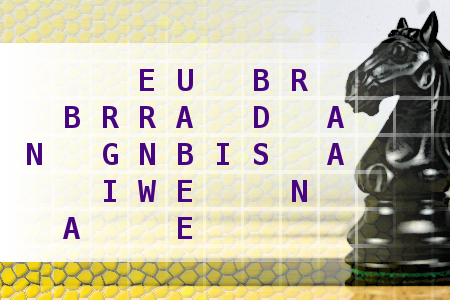
[4714] Chess Knight Move - Find the country and its capital city, using the move of a chess knight. First letter is B. Length of words in solution: 6,6,4,7. - #brainteasers #wordpuzzles #chessknightmove - Correct Answers: 24 - The first user who solved this task is Djordje Timotijevic
BRAIN TEASERS
enter your answer and press button OK

Chess Knight Move

Find the country and its capital city, using the move of a chess knight. First letter is B. Length of words in solution: 6,6,4,7.
Correct answers: 24
The first user who solved this task is Djordje Timotijevic.
#brainteasers #wordpuzzles #chessknightmove
Register with your Google Account and start collecting points.
Check your ranking on list.

An absent-minded husband thoug...

An absent-minded husband thought he had conquered his problem of trying to remember his wife's birthday and their anniversary.
He opened an account with a florist, provided that florist with the dates and instructions to send flowers to his wife on these dates along with an appropriate note signed, "Your loving husband."
His wife was thrilled by this new display of attention and all went well until one day, when he came home, kissed his wife and said offhandedly, "Nice flowers, honey. Where'd you get them?"
Jokes of the day - Daily updated jokes. New jokes every day.
Follow Brain Teasers on social networks

Brain Teasers

puzzles, riddles, mathematical problems, mastermind, cinemania...

Christian Jürgensen Thomsen

Born 29 Dec 1788; died 21 May 1865 at age 76.Danish archaeologist whose designation of the Stone, Iron and Bronze Ages became widely accepted. He was the first curator of the National Museum of Denmark, Copenhagen (1816). He classified the specimens in this tripartite way, on the basis of the material used in making weapons and tools, while he was organising the museum exhibits to show man's progressive cultural and technological development in Europe. It was adopted as the basis of chronological schemes elsewhere in the world by generations of archaeologists. In 1841, he established the first ethnographic museum. In 1849, he became director of the National Museum. He was one of the first to open collections to the public free of charge in the interests of popular education.«
This site uses cookies to store information on your computer. Some are essential to help the site properly. Others give us insight into how the site is used and help us to optimize the user experience. See our privacy policy.