Chess Knight Move
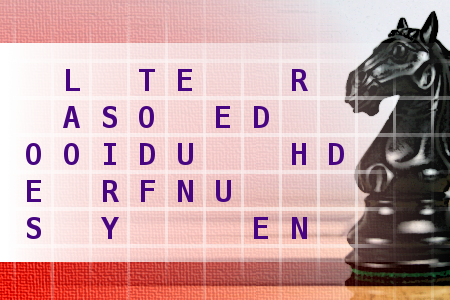
[5253] Chess Knight Move - Find the title of novel, using the move of a chess knight. First letter is O. Length of words in solution: 3,7,5,2,8. - #brainteasers #wordpuzzles #chessknightmove - Correct Answers: 21 - The first user who solved this task is Djordje Timotijevic
BRAIN TEASERS
enter your answer and press button OK

Chess Knight Move

Find the title of novel, using the move of a chess knight. First letter is O. Length of words in solution: 3,7,5,2,8.
Correct answers: 21
The first user who solved this task is Djordje Timotijevic.
#brainteasers #wordpuzzles #chessknightmove
Register with your Google Account and start collecting points.
Check your ranking on list.

Dad, What is sex?

An 8-year-old girl asks her father, "Daddy, what is sex?" The father is somewhat surprised that she would ask such a question.

But, he reckons if she's old enough to ask the question, then surely she's old enough for a straight answer.

So, the father proceeds to tell his young daughter all about the "birds and the bees."
After a brief explanation, the little girl appears wide-eyed in disbelief. "By the way, dear, why do you ask?" the father asks.

The little girl replies, "Mommy told me to tell you that dinner would be ready in just a couple of secs."

Jokes of the day - Daily updated jokes. New jokes every day.
Follow Brain Teasers on social networks

Brain Teasers

puzzles, riddles, mathematical problems, mastermind, cinemania...

Chester F. Carlson

Died 19 Sep 1968 at age 62 (born 8 Feb 1906). Chester Floyd Carlson was an American physicist who invented xerography (22 Oct 1938), an electrostatic dry-copying process that found applications ranging from office copying to reproducing out-of-print books. The process involved sensitizing a photoconductive surface to light by giving it an electrostatic charge Carlson developed it between 1934 and 1938, and initially described it as electrophotography It was immediately protected by Carlson with an impenetrable web of patents, though it was not until 1944 that he was able to obtain funding for further development. In 1947 he sold the commercial rights for his invention to the Haloid Company, a small manufacturer of photographic paper (which later became the Xerox Corporation).
This site uses cookies to store information on your computer. Some are essential to help the site properly. Others give us insight into how the site is used and help us to optimize the user experience. See our privacy policy.