Chess Knight Move
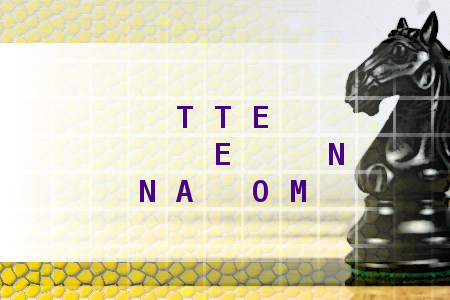
[5329] Chess Knight Move - Find the title of novel, using the move of a chess knight. First letter is A. Length of words in solution: 9. - #brainteasers #wordpuzzles #chessknightmove - Correct Answers: 32 - The first user who solved this task is Djordje Timotijevic
BRAIN TEASERS
enter your answer and press button OK

Chess Knight Move

Find the title of novel, using the move of a chess knight. First letter is A. Length of words in solution: 9.
Correct answers: 32
The first user who solved this task is Djordje Timotijevic.
#brainteasers #wordpuzzles #chessknightmove
Register with your Google Account and start collecting points.
Check your ranking on list.

Drunken argument...

Two drunks are walking along. One drunk says to the other, "What a beautiful night. Look at that moon!"

The other drunk stops and looks at his drunk friend. "You are wrong. That's not the moon; that's the sun!"

Both continued arguing for awhile when they came upon another drunk walking along. So they stopped him and said, "Sir, could you please help settle our argument? Tell us what that thing is up in the sky that's shining. Is it the moon or the sun?"

The third drunk look at the sky and then looked at them and said, "Sorry, I don't live around here."

Jokes of the day - Daily updated jokes. New jokes every day.
Follow Brain Teasers on social networks

Brain Teasers

puzzles, riddles, mathematical problems, mastermind, cinemania...

Atle Selberg

Born 14 Jun 1917; died 6 Aug 2007 at age 90.Norwegian mathematician who is one of the foremost analytic number theorists. After working in isolation during WW II, due to the occupation of Norway by the Nazis, his accomplishments in the theory of the Riemann zeta function became known. During the 1950's he developed the Selberg trace formula, his most famous accomplishment. It establishes a duality between the length spectrum of a Riemann surface and the eigenvalues of the Laplacian which is analogous to the duality between the prime numbers and the zeros of the zeta function. He was awarded the Fields Medal in 1950 for his work in number theory on generalisations of the sieve methods of Viggo Brun. In 1986 he won the Wolf Prize.
This site uses cookies to store information on your computer. Some are essential to help the site properly. Others give us insight into how the site is used and help us to optimize the user experience. See our privacy policy.