Chess Knight Move
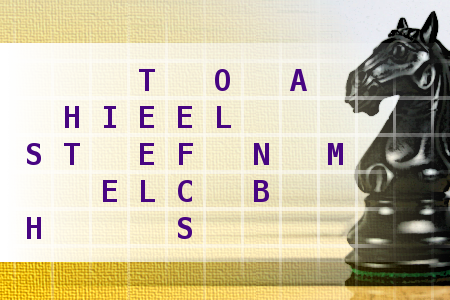
[6582] Chess Knight Move - Find the title of movie, using the move of a chess knight. First letter is T. Length of words in solution: 3,7,2,3,5. - #brainteasers #wordpuzzles #chessknightmove - Correct Answers: 14 - The first user who solved this task is Fazil Hashim
BRAIN TEASERS
enter your answer and press button OK

Chess Knight Move

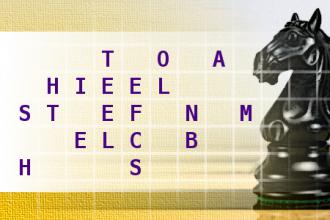
Find the title of movie, using the move of a chess knight. First letter is T. Length of words in solution: 3,7,2,3,5.
Correct answers: 14
The first user who solved this task is Fazil Hashim.
#brainteasers #wordpuzzles #chessknightmove
Register with your Google Account and start collecting points.
Check your ranking on list.

Assignment Difficulty

An elementary school teacher decides to pole the class on the difficulty of last night’s homework assignment:
How many people were able to complete the assignment without parents help?
About 25% of the class raises their hands. How many people we able to complete the assignment with the help of a parent? About 70% of the class raises their hand. The teacher still notices about 5% of the class did not raise their hands.
She then calls out, "How many people had to help a parent complete your assignment?

Jokes of the day - Daily updated jokes. New jokes every day.
Follow Brain Teasers on social networks

Brain Teasers

puzzles, riddles, mathematical problems, mastermind, cinemania...

Jean Perrin

Died 17 Apr 1942 at age 71 (born 30 Sep 1870). Jean-Baptiste Perrin was a French physicist who, in his studies of the Brownian motion of minute particles suspended in liquids, verified Albert Einstein's explanation of this phenomenon and thereby confirmed the atomic nature of matter. Using a gamboge emulsion, Perrin was able to determine by a new method, one of the most important physical constants, Avogadro's number (the number of molecules of a substance in so many grams as indicated by the molecular weight, for example, the number of molecules in two grams of hydrogen). The value obtained corresponded, within the limits of error, to that given by the kinetic theory of gases. For this achievement he was honoured with the Nobel Prize for Physics in 1926.
This site uses cookies to store information on your computer. Some are essential to help the site properly. Others give us insight into how the site is used and help us to optimize the user experience. See our privacy policy.