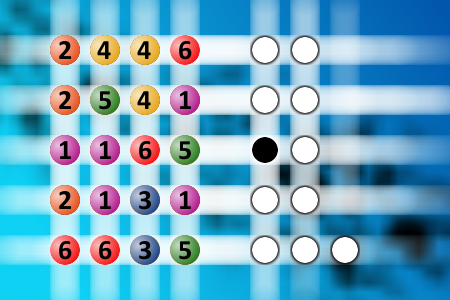
What a winning combination?
[6581] What a winning combination? - The computer chose a secret code (sequence of 4 digits from 1 to 6). Your goal is to find that code. Black circles indicate the number of hits on the right spot. White circles indicate the number of hits on the wrong spot. - #brainteasers #mastermind - Correct Answers: 21 - The first user who solved this task is Nasrin 24 T
BRAIN TEASERS
enter your answer and press button OK

What a winning combination?

The computer chose a secret code (sequence of 4 digits from 1 to 6). Your goal is to find that code. Black circles indicate the number of hits on the right spot. White circles indicate the number of hits on the wrong spot.
Correct answers: 21
The first user who solved this task is Nasrin 24 T.
#brainteasers #mastermind
Register with your Google Account and start collecting points.
Check your ranking on list.

A grocer put up a sign that re...

A grocer put up a sign that read "Eggplants, 25 cents each — three for a dollar."
All day long, customers came in exclaiming: "Don't be ridiculous! I should get four for a dollar!"
Meekly the grocer agreed and packaged four eggplants. The tailor next door had been watching these antics and finally asked the grocer, "Aren't you going to fix the mistake on your sign?"
"What mistake?" the grocer asked. "Before I put up that sign no one ever bought more than one eggplant."
Jokes of the day - Daily updated jokes. New jokes every day.
Follow Brain Teasers on social networks

Brain Teasers

puzzles, riddles, mathematical problems, mastermind, cinemania...

Charles Barkla

Born 7 Jun 1877; died 23 Oct 1944 at age 67.Charles Glover Barkla was an English physicist who was awarded the Nobel Prize for Physics in 1917 for his work on X-ray scattering. This technique is applied to the investigation of atomic structures, by studying how X-rays passing through a material and are deflected by the atomic electrons. In 1903, he showed that the scattering of x-rays by gases depends on the molecular weight of the gas. His experiments on the polarization of x-rays (1904) and the direction of scattering of a beam of x-rays (1907) showed X-rays to be electromagnetic radiation like light (whereas, at the time, William Henry Bragg who held that X-rays were particles.) Barkla further discovered that each element has its own characteristic x-ray spectrum.«
This site uses cookies to store information on your computer. Some are essential to help the site properly. Others give us insight into how the site is used and help us to optimize the user experience. See our privacy policy.