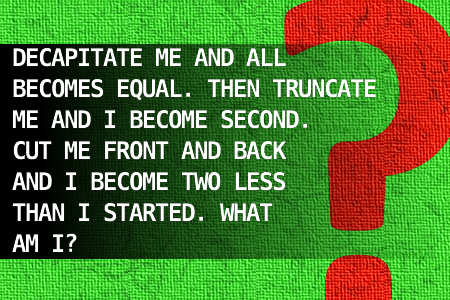
Decapitate me and all becomes ...
Decapitate me and all becomes equal. Then truncate me and I become second. Cut me front and back and I become two less than I started. What am I?Correct answers: 42
The first user who solved this task is Roxana zavari.
#brainteasers #riddles

A Good Day for Ice Fishing
After church, little Johnny and his brother go ice fishing. Little Johnny starts drilling on the ice when a voice from above says, "Young man, there's no fish down there.”
Little Johnny asks his brother, "Who is that?"
His brother replies, "I don't know."
So little Johnny starts to drill again and the voice says again, "For the second time, there's no fish down there."
Little Johnny asks his brother, "Could that be God?"
His brother replies again, "I don't know."
Little Johnny starts drilling again and the voice says once more, "Young man, for the last time, I'm telling you there's no fish down there."
Johnny looks up and asks, "Is that you, God?"
The voice says, "No, I'm the manager and the rink's closed."
Little Johnny asks his brother, "Who is that?"
His brother replies, "I don't know."
So little Johnny starts to drill again and the voice says again, "For the second time, there's no fish down there."
Little Johnny asks his brother, "Could that be God?"
His brother replies again, "I don't know."
Little Johnny starts drilling again and the voice says once more, "Young man, for the last time, I'm telling you there's no fish down there."
Johnny looks up and asks, "Is that you, God?"
The voice says, "No, I'm the manager and the rink's closed."