Decrypt hidden message
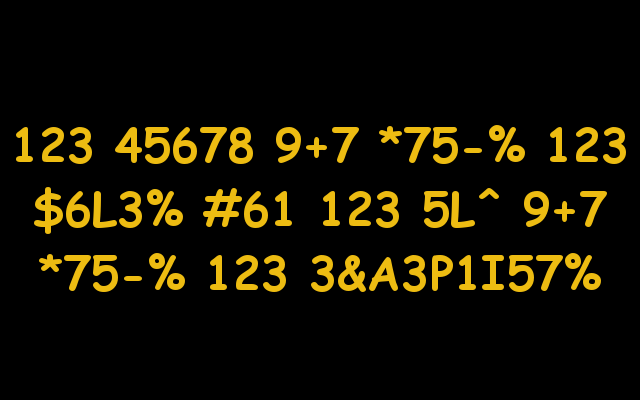
[2545] Decrypt hidden message - Can you decrypt hidden message (123 45678 9+7 *75-% 123 $6L3% #61 123 5L^ 9+7 *75-% 123 3&A3P1I57%)? - #brainteasers #wordpuzzles #riddles - Correct Answers: 14 - The first user who solved this task is Lee Gross
BRAIN TEASERS
enter your answer and press button OK

Decrypt hidden message

Can you decrypt hidden message (123 45678 9+7 *75-% 123 $6L3% #61 123 5L^ 9+7 *75-% 123 3&A3P1I57%)?
Correct answers: 14
The first user who solved this task is Lee Gross.
#brainteasers #wordpuzzles #riddles
Register with your Google Account and start collecting points.
Check your ranking on list.

The End Of The Ham

A young woman was preparing a ham dinner. After she cut off the end of the ham, she placed it in a pan for baking.

Her friend asked her,”Why did you cut off the end of the ham”?

And she replied ,”I really don’t know but my mother always did, so I thought you were supposed to.”

Later when talking to her mother she asked her why she cut off the end of the ham before baking it, and her mother replied, “I really don’t know, but that’s the way my mom always did it.”

A few weeks later while visiting her grandmother, the young woman asked, “Grandma, why is it that you cut off the end of a ham before you bake it?”

Her grandmother replied, “Well dear, otherwise it would never fit into my baking pan.”

Jokes of the day - Daily updated jokes. New jokes every day.
Follow Brain Teasers on social networks

Brain Teasers

puzzles, riddles, mathematical problems, mastermind, cinemania...

Franz Joseph Gall

Born 9 Mar 1758; died 22 Aug 1828 at age 70. German physician, anatomist and physiologistt who pioneered in linking cerebral functions to localized areas of the brain and associated with underlying attributes of the human personality. As early as the 1790s, he was developing theories on the anatomy and function of the parts of the brain. He was first to identify recognize that the brain's gray matter was made up of nerve cell bodies, and that the white matter has the fibers that carry impulses from the nerves. He believed an external examination of the skull could reveal individual intellect and personality, which he termed “cranioscopy,” later called “phrenology” by his protegé, Johann G. Spurzheim. In 1805, they travelled on a long lecture tour of Europe, also studying at prisons and asylums.«
This site uses cookies to store information on your computer. Some are essential to help the site properly. Others give us insight into how the site is used and help us to optimize the user experience. See our privacy policy.