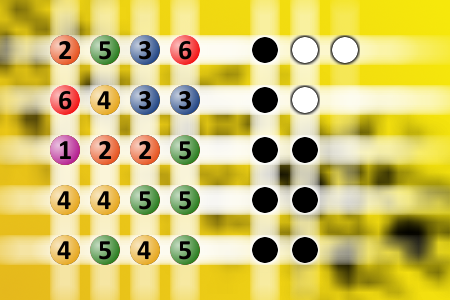
Which is a winning combination of digits?
[6628] Which is a winning combination of digits? - The computer chose a secret code (sequence of 4 digits from 1 to 6). Your goal is to find that code. Black circles indicate the number of hits on the right spot. White circles indicate the number of hits on the wrong spot. - #brainteasers #mastermind - Correct Answers: 18 - The first user who solved this task is Nasrin 24 T
BRAIN TEASERS
enter your answer and press button OK

Which is a winning combination of digits?

The computer chose a secret code (sequence of 4 digits from 1 to 6). Your goal is to find that code. Black circles indicate the number of hits on the right spot. White circles indicate the number of hits on the wrong spot.
Correct answers: 18
The first user who solved this task is Nasrin 24 T.
#brainteasers #mastermind
Register with your Google Account and start collecting points.
Check your ranking on list.

Naming the Twins

A man was taking his wife, who was pregnant with twins, to the hospital when his car went out of control and crashed.
Regaining consciousness, he saw his brother, a relentless practical joker, sitting at his bed side.
He asked his brother how his wife was doing and his brother said, "Don't worry, everybody is fine and you have a son and a daughter.
But the hospital was in a real hurry to get the birth certificates filed and since both you and your wife were unconscious, I named them for you."
The husband was thinking to himself, "Oh no, what has he done now?" and asked with some trepidation, "Well, bro, what did you name them?"
Whereupon, his brother replied, "I named the little girl Denise."
The husband, relieved, said, "That's a lovely name! And what did you come up with for my son?"
The brother winked and replied, "Denephew."

Jokes of the day - Daily updated jokes. New jokes every day.
Follow Brain Teasers on social networks

Brain Teasers

puzzles, riddles, mathematical problems, mastermind, cinemania...

Sir William Ramsay

Born 2 Oct 1852; died 23 Jul 1916 at age 63. Scottish chemist who discovered who discovered neon, krypton and xenon and co-discovered argon, radon, calcium and barium. He was awarded the Nobel Prize in Chemistry in 1904, “in recognition of his services in the discovery of the inert gaseous elements in air, and his determination of their place in the periodic system.” The so-called “inert gases” are now known as “noble gases” because some examples of reactions have been discovered.
This site uses cookies to store information on your computer. Some are essential to help the site properly. Others give us insight into how the site is used and help us to optimize the user experience. See our privacy policy.