
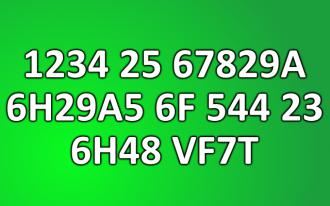
Decrypt the message
[2698] Decrypt the message - Can you decrypt hidden message (1234 25 67829A 6H29A5 6F 544 23 6H48 VF7T)? - #brainteasers #wordpuzzles #riddles - Correct Answers: 15 - The first user who solved this task is Donya Sayah30
BRAIN TEASERS
enter your answer and press button OK

Decrypt the message

Can you decrypt hidden message (1234 25 67829A 6H29A5 6F 544 23 6H48 VF7T)?
Correct answers: 15
The first user who solved this task is Donya Sayah30.
#brainteasers #wordpuzzles #riddles
Register with your Google Account and start collecting points.
Check your ranking on list.

A guy walking down a street on...

A guy walking down a street one afternoon passes an old man sitting on the side of the road with a large sack.
The younger guy says to the old man, "Watcha got in the sack?"
The old man responds, "I got some monkeys in that there sack."
The younger man asks, "If I guess how many monkeys you got in the sack, can I keep one?"
The old man replies, "Son, if you guess how many monkeys I got in this sack, I'll give you both of 'em!"
Jokes of the day - Daily updated jokes. New jokes every day.
Follow Brain Teasers on social networks

Brain Teasers

puzzles, riddles, mathematical problems, mastermind, cinemania...

Cavendish Laboratory

In 1874, the Cavendish Laboratory was opened at the University of Cambridge, England. It was built as a teaching laboratory with a regular course of instruction - a new idea for the time. Until then, much of experimental physics was conducted as individual work in essentially private laboratories. Joule and Cavendish, for example, set up their facilities in their own home, at their own expense. An early exception was the laboratory at the University of Glasgow established in the 1840's by William Thompson (later Lord Kelvin). The first Cavendish Professor (1871-1879) was James Clerk-Maxwell, followed by Lord Rayleigh (1879-1884), who both much expanded knowledge of physics. The third Cavendish Professor was J.J. Thomson, discoverer of the electron.«*
This site uses cookies to store information on your computer. Some are essential to help the site properly. Others give us insight into how the site is used and help us to optimize the user experience. See our privacy policy.