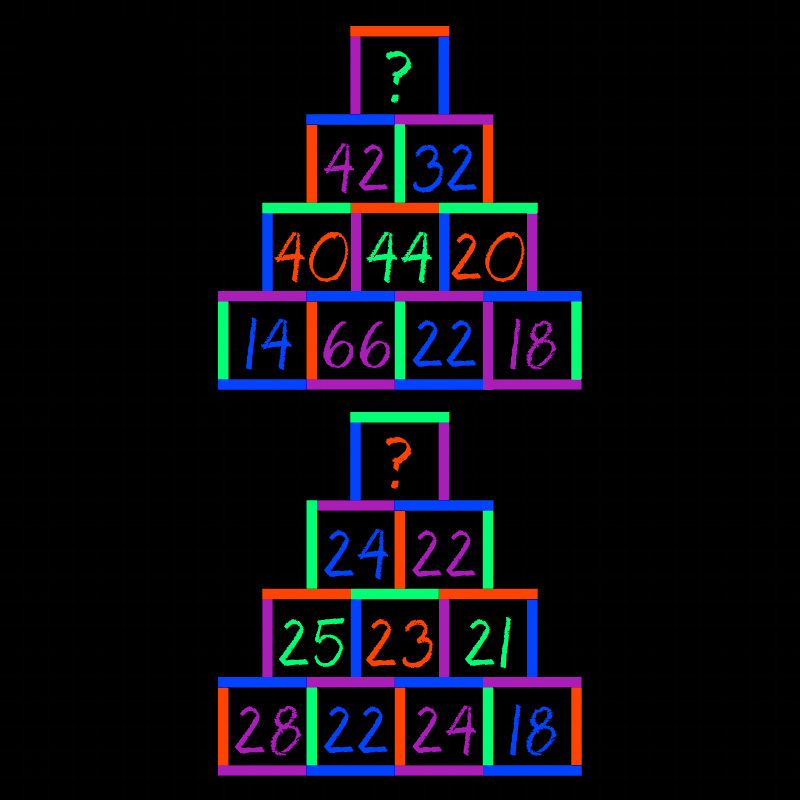
FUNNY MATH: Find the product...
[4195] FUNNY MATH: Find the product... - FUNNY MATH: Find the product of the missing numbers. - #brainteasers #math - Correct Answers: 45 - The first user who solved this task is Djordje Timotijevic
BRAIN TEASERS
enter your answer and press button OK

FUNNY MATH: Find the product...

FUNNY MATH: Find the product of the missing numbers.
Correct answers: 45
The first user who solved this task is Djordje Timotijevic.
#brainteasers #math
Register with your Google Account and start collecting points.
Check your ranking on list.

A funeral service is being hel...

A funeral service is being held in a synagogue for a woman who has just passed away. At the end of the service, the pall bearers are carrying the casket out when they accidentally bump into a wall jarring the casket.
They hear a faint moan. They open the casket and find that the woman is actually alive. She lives for 10 more years and then dies.
A ceremony is again held at the same synagogue and at the end of the ceremony the pall bearers are again carrying the casket.
As they are walking the husband cries out, "Watch out for the wall!"
Jokes of the day - Daily updated jokes. New jokes every day.
Follow Brain Teasers on social networks

Brain Teasers

puzzles, riddles, mathematical problems, mastermind, cinemania...

Baron William Thomson Kelvin

Died 17 Dec 1907 at age 83 (born 26 Jun 1824). Irish physicist, mathematician and engineer who became an influential physicist, who has been described as the Newton of his era. Born as William Thomson in Ireland. At Glasgow University, Scotland, he was a professor for over half a century. The name he made for himself was more than just a temperature scale. His activities ranged from being the brains behind the laying of a transatlantic telephone cable, to attempting to calculate the age of the earth from its rate of cooling. In 1892, when raised to the peerage as Baron Kelvin of Largs, he had chosen the name from the Kelvin River, near Glasgow. He is often described as a Scottish scientist because of his life career spent in Glasgow, but late in life, in a lecture in 1883, he referred to himself as an Irishman.
This site uses cookies to store information on your computer. Some are essential to help the site properly. Others give us insight into how the site is used and help us to optimize the user experience. See our privacy policy.