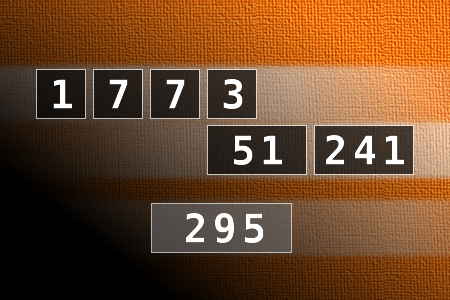
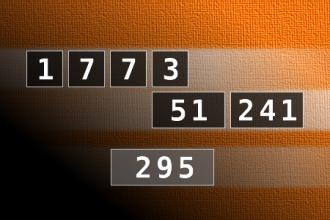
Calculate the number 295
[4196] Calculate the number 295 - NUMBERMANIA: Calculate the number 295 using numbers [1, 7, 7, 3, 51, 241] and basic arithmetic operations (+, -, *, /). Each of the numbers can be used only once. - #brainteasers #math #numbermania - Correct Answers: 25 - The first user who solved this task is Djordje Timotijevic
BRAIN TEASERS
enter your answer and press button OK

Calculate the number 295

NUMBERMANIA: Calculate the number 295 using numbers [1, 7, 7, 3, 51, 241] and basic arithmetic operations (+, -, *, /). Each of the numbers can be used only once.
Correct answers: 25
The first user who solved this task is Djordje Timotijevic.
#brainteasers #math #numbermania
Register with your Google Account and start collecting points.
Check your ranking on list.

Proud Of Daddy

Three boys are in the schoolyard bragging about their fathers.

The first boy says, "My dad scribbles a few words on a piece of paper, he calls it a poem, and they give him $50."

The second boy says, "That's nothing. My dad scribbles a few words on a piece of paper, he calls it a song, and they give him $100."

The third boy says, "I got you both beat. My dad scribbles a few words on a piece of paper, calls it a sermon, and it takes eight people to collect all the money!"

Jokes of the day - Daily updated jokes. New jokes every day.
Follow Brain Teasers on social networks

Brain Teasers

puzzles, riddles, mathematical problems, mastermind, cinemania...

Donald B. Keck

Born 2 Jan 1941.American research physicist, who with his colleagues at Corning Glass, Dr. Robert Maurer and Dr. Peter Schultz, invented fused silica optical waveguide - optical fiber. This was a breakthrough creating a revolution in telecommunications, capable of carrying 65,000 times more information than conventional copper wire. In 1970, Maurer, Keck, and Schultz solved a problem that had previously stumped scientists around the world. They designed and produced the first optical fiber with optical losses low enough for wide use in telecommunications. The light loss was limited to 20 decibels per kilometer (at least one percent of the light entering a fiber remains after traveling one kilometer).
This site uses cookies to store information on your computer. Some are essential to help the site properly. Others give us insight into how the site is used and help us to optimize the user experience. See our privacy policy.