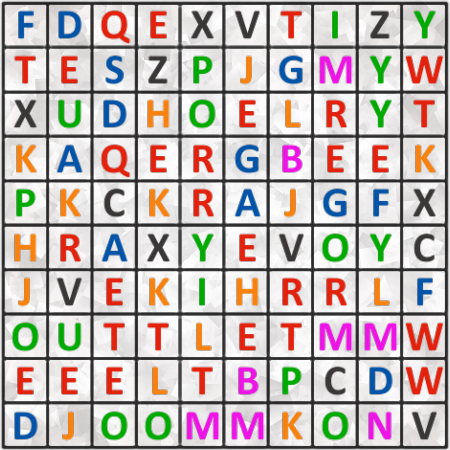
Find a famous person
[2019] Find a famous person - Find the first and the last name of a famous person. Text may go in all 8 directions. Length of words in solution: 5,7. - #brainteasers #wordpuzzles - Correct Answers: 42 - The first user who solved this task is Djordje Timotijevic
BRAIN TEASERS
enter your answer and press button OK

Find a famous person

Find the first and the last name of a famous person. Text may go in all 8 directions. Length of words in solution: 5,7.
Correct answers: 42
The first user who solved this task is Djordje Timotijevic.
#brainteasers #wordpuzzles
Register with your Google Account and start collecting points.
Check your ranking on list.

Friendship between wom...

Friendship between women: A woman doesn’t come home one night. The next day she tells her husband that she had slept over at a girlfriend's house.
The husband calls his wife's 10 best friends. None of them know anything about it.
Friendship between men: A man doesn’t come home one night. The next day he tells his wife that he had slept over at a friend’s house. The wife calls her husband's 10 best men friends. Eight of them confirm that he had slept over, and two claim that he was still there.
Jokes of the day - Daily updated jokes. New jokes every day.
Follow Brain Teasers on social networks

Brain Teasers

puzzles, riddles, mathematical problems, mastermind, cinemania...

Charles Manning Child

Died 19 Dec 1954 at age 85 (born 2 Feb 1869). American zoologist known for work on sensitivity and reactivity of animal organisms, but especially on reproduction, development, and especially regeneration. In 1911, he formulated the axial gradient theory. He believed that when a simple animal regenerates after an injury, the physiological stages occur along an axis, with each successive process appearing to be connected with the stage immediately preceeding it. He observed a similarity between such regeneration and embryonic development in that the dominant section is formed first, with the lesser ones following. Though present knowledge views his theory as incorrect, in its time, it represented an early approach to understanding functional organization within organisms.«
This site uses cookies to store information on your computer. Some are essential to help the site properly. Others give us insight into how the site is used and help us to optimize the user experience. See our privacy policy.