Solve This Number Puzzle
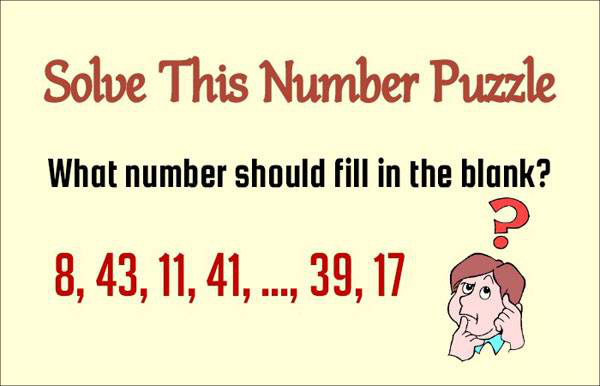
[2020] Solve This Number Puzzle - What number should fill in the blank? (8, 43, 11, 41, ?, 39, 17) - #brainteasers #math #riddles - Correct Answers: 215 - The first user who solved this task is Chindu Cho
BRAIN TEASERS
enter your answer and press button OK

Solve This Number Puzzle

What number should fill in the blank? (8, 43, 11, 41, ?, 39, 17)
Correct answers: 215
The first user who solved this task is Chindu Cho.
#brainteasers #math #riddles
Register with your Google Account and start collecting points.
Check your ranking on list.

There were three little boys v...

There were three little boys visiting their grandparents.
The oldest came out and asked his grandpa, "Can you make a sound like a frog, Grandpappy?
Grandpa (being in a kind of ill mood) responds, "No, I don't really want to make the sound of a frog now."
So, the second little boy comes out and asks his grandfather, "Will you please make a sound like a frog?"
Grandpa again says, "No, not now. I don't really want to do that.I'm in a grumpy mood. Maybe later."
Then the third little boy comes out and says, "Grandpa, oh please...Please, please will you make a sound like a frog?"
"Why do all of you boys want me to make a sound like a frog?" Grandpa asked.
The little boy replied with a hopeful face, "Well, Mom said that when you croak, we get to go to Disney World!"
Jokes of the day - Daily updated jokes. New jokes every day.
Follow Brain Teasers on social networks

Brain Teasers

puzzles, riddles, mathematical problems, mastermind, cinemania...

Walter Noddack

Born 17 Aug 1893; died 7 Dec 1960 at age 67.Walter Karl Friedrich Noddack was a German chemist who discovered the element rhenium (Jun 1925) in collaboration with his wife Ida Tacke. In 1922, he began a long search for undiscovered elements. After three years, the careful fractionation of certain ores yielded element 75, a rare heavy metallic element that resembles manganese. Named rhenium after the Rhine River, it was the last stable element to be discovered. Noddack is also remembered for arguing for a concept he called allgegenwartskonzentration or, literally, omnipresent concentration. This idea, reminiscent of Greek philosopher Anaxagoras, assumed that every mineral actually contained every element. The reason they could not all be detected was they existed in too small quantities.
This site uses cookies to store information on your computer. Some are essential to help the site properly. Others give us insight into how the site is used and help us to optimize the user experience. See our privacy policy.