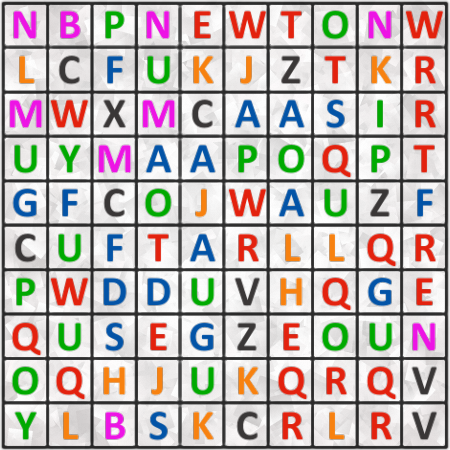
Find a famous person
[2220] Find a famous person - Find the first and the last name of a famous person. Text may go in all 8 directions. - #brainteasers #wordpuzzles - Correct Answers: 53 - The first user who solved this task is On On Lunarbasil
BRAIN TEASERS
enter your answer and press button OK

Find a famous person

Find the first and the last name of a famous person. Text may go in all 8 directions.
Correct answers: 53
The first user who solved this task is On On Lunarbasil.
#brainteasers #wordpuzzles
Register with your Google Account and start collecting points.
Check your ranking on list.

The pickle slicer

Bill worked in a pickle factory. He had been employed there for many years when he came home one day to confess to his wife that he had a terrible compulsion. He had an urge to stick his penis into the pickle slicer.

His wife suggested that he should see a sex therapist to talk about it, but Bill said he would be too embarrassed. He vowed to overcome the compulsion on his own.

One day a few weeks later, Bill came home and his wife could see at once that something was seriously wrong.

"What's wrong, Bill?" she asked.

"Do you remember that I told you how I had this tremendous urge to put my penis into the pickle slicer?"

"Oh, Bill, you didn't!" she exclaimed.

"Yes, I did," he replied.

"My God, Bill, what happened?" she asked.

"I got fired," he replied.

"No, Bill. I mean, what happened with the pickle slicer?" she demanded.

"Oh... she got fired too."

Jokes of the day - Daily updated jokes. New jokes every day.
Follow Brain Teasers on social networks

Brain Teasers

puzzles, riddles, mathematical problems, mastermind, cinemania...

Cecilia Payne

Died 7 Dec 1979 at age 79 (born 10 May 1900).Cecilia Helena Payne-Gaposchkin was an English-American astronomer who was the first to apply laws of atomic physics to the study of the temperature and density of stellar bodies, and the first to conclude that hydrogen and helium are the two most common elements in the universe. During the 1920s, the accepted explanation of the Sun's composition was a calculation of around 65% iron and 35% hydrogen. At Harvard University, in her doctoral thesis (1925), Payne claimed that the sun's spectrum was consistent with another solution: 99% hydrogen with helium, and just 1% iron. She had difficulty persuading her superiors to take her work seriously. It was another 20 years before Payne's original claim was confirmed, by Fred Hoyle.
This site uses cookies to store information on your computer. Some are essential to help the site properly. Others give us insight into how the site is used and help us to optimize the user experience. See our privacy policy.