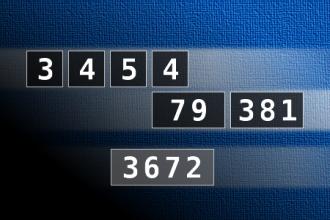
Calculate the number 3672
[7011] Calculate the number 3672 - NUMBERMANIA: Calculate the number 3672 using numbers [3, 4, 5, 4, 79, 381] and basic arithmetic operations (+, -, *, /). Each of the numbers can be used only once. - #brainteasers #math #numbermania - Correct Answers: 9 - The first user who solved this task is Nasrin 24 T
BRAIN TEASERS
enter your answer and press button OK

Calculate the number 3672

NUMBERMANIA: Calculate the number 3672 using numbers [3, 4, 5, 4, 79, 381] and basic arithmetic operations (+, -, *, /). Each of the numbers can be used only once.
Correct answers: 9
The first user who solved this task is Nasrin 24 T.
#brainteasers #math #numbermania
Register with your Google Account and start collecting points.
Check your ranking on list.

My Wife a Chicken

A man runs to the doctor and says, "Doctor, you've got to help me. My wife thinks she's a chicken!"
The doctor asks, "How long has she had this condition?"
"Two years," says the man.
"Then why did it take you so long to come and see me?" asked the shrink.
The man shrugs his shoulders and replies, "We needed the eggs."

Jokes of the day - Daily updated jokes. New jokes every day.
Follow Brain Teasers on social networks

Brain Teasers

puzzles, riddles, mathematical problems, mastermind, cinemania...

Jean le Rond D'Alembert

Born 16 Nov 1717; died 29 Oct 1783 at age 65. French mathematician known for his work in various fields of applied mathematics, in particular dynamics. In 1743 he published his Traité de dynamique (Treatise on Dynamics). The d'Alembert principle extends Newton's third law of motion, that Newton's law holds not only for fixed bodies but also for free moving bodies. D'Alembert also wrote on fluid dynamics, the theory of winds, the properties of vibrating strings and conducted experiments on the properties of sound . His most significant purely mathematical innovation was his invention and development of the theory of partial differential equations. He published eight volumes of mathematical studies (1761-80). He was editor of the mathematical and scientific articles for Denis Diderot's Encyclopédie.
This site uses cookies to store information on your computer. Some are essential to help the site properly. Others give us insight into how the site is used and help us to optimize the user experience. See our privacy policy.