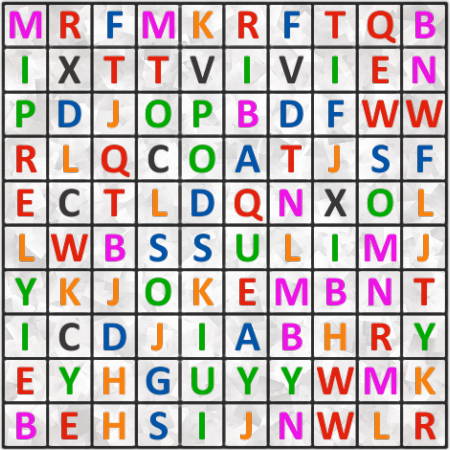
Find a famous person
[4132] Find a famous person - Find the first and the last name of a famous person. Text may go in all 8 directions. Length of words in solution: 6,5. - #brainteasers #wordpuzzles - Correct Answers: 25 - The first user who solved this task is Manguexa Wagle
BRAIN TEASERS
enter your answer and press button OK

Find a famous person

Find the first and the last name of a famous person. Text may go in all 8 directions. Length of words in solution: 6,5.
Correct answers: 25
The first user who solved this task is Manguexa Wagle.
#brainteasers #wordpuzzles
Register with your Google Account and start collecting points.
Check your ranking on list.

Gourmet Reporter

A magazine reporter is traveling through a rainforest, in search of a fabled cannibalistic tribe. He falls into a trap, goes unconscious and wakes up tied to a stake with a fire burning slowly underneath him.

He cries out for help, and is answered by what is obviously one of the tribesmen, who informs him that he is going to be served as dinner to the leader of the tribe.

"But you don't understand!" he cries, "You can't do this to me! I'm an editor for the New Yorker magazine!"

"Ah," replies the tribesman, "Well soon you will be editor-in-chief!"

Jokes of the day - Daily updated jokes. New jokes every day.
Follow Brain Teasers on social networks

Brain Teasers

puzzles, riddles, mathematical problems, mastermind, cinemania...

Indelible pencil

In 1866, the first U.S. patent for an indelible pencil was issued to Edson P Clark of Northampton, Mass. as an "Producing Indelible Writing on Linen and other Fabrics" (No. 56,180). The pencil-lead was composed of gypsum (a hard moisture-resistance compound) and black lead (coloring agent, with optional asphaltum or lamp-black) and silver nitrate. It is the silver nitrate which blackens to make the indelible mark by the action of light or heat. The black lead and gypsum permit the pencil to be readily pointed. The patent described cementing the filling with shellac into grooved cedar wood. Clark held an earlier patent for an indelible composition, but described without the wood jacket (No. 24,195 on 31 May 1859).
This site uses cookies to store information on your computer. Some are essential to help the site properly. Others give us insight into how the site is used and help us to optimize the user experience. See our privacy policy.