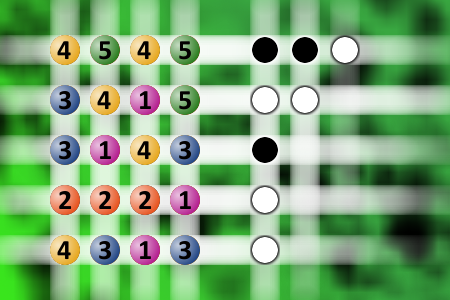
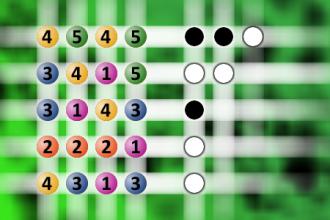
Which is a winning combination of digits?
The computer chose a secret code (sequence of 4 digits from 1 to 6). Your goal is to find that code. Black circles indicate the number of hits on the right spot. White circles indicate the number of hits on the wrong spot.Correct answers: 44
The first user who solved this task is Thinh Ddh.
#brainteasers #mastermind

Short Cowboy Jokes
Q: What do you call a drug ring in Dallas?
A: A huddle.
Q: Four Dallas Cowboys in a car, who's driving?
A: The police.
Q: Why can't Michael Irvin get into a huddle on the field anymore?
A: It is a parole violation for him to associate with known felons.
The Dallas newspapers reported yesterday that Texas Stadium is going to take out the artificial turf because the cowboys play better on "grass."
The Dallas Cowboys adopted a new "Honor System", Yes your Honor, No your Honor.
The Cowboys had a 12 and 5 season this year, 12 arrests, 5 convictions.
The Cowboys knew they had to do something for their defense, so they hired a new defensive coordinator: Johnny Cochran
Q: How do the Dallas Cowboys spend their first week at spring training?
A: Studying their Miranda Rights.
A: A huddle.
Q: Four Dallas Cowboys in a car, who's driving?
A: The police.
Q: Why can't Michael Irvin get into a huddle on the field anymore?
A: It is a parole violation for him to associate with known felons.
The Dallas newspapers reported yesterday that Texas Stadium is going to take out the artificial turf because the cowboys play better on "grass."
The Dallas Cowboys adopted a new "Honor System", Yes your Honor, No your Honor.
The Cowboys had a 12 and 5 season this year, 12 arrests, 5 convictions.
The Cowboys knew they had to do something for their defense, so they hired a new defensive coordinator: Johnny Cochran
Q: How do the Dallas Cowboys spend their first week at spring training?
A: Studying their Miranda Rights.