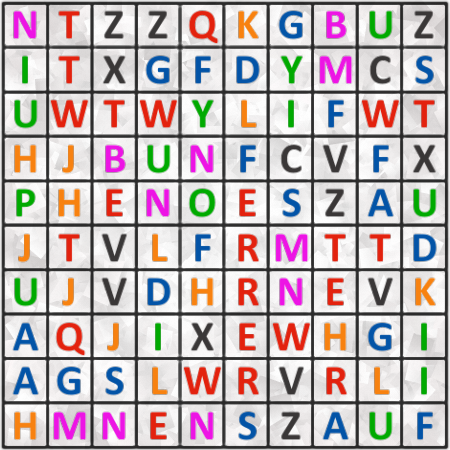
Find a famous person
[4491] Find a famous person - Find the first and the last name of a famous person. Text may go in all 8 directions. Length of words in solution: 5,6. - #brainteasers #wordpuzzles - Correct Answers: 20 - The first user who solved this task is Manguexa Wagle
BRAIN TEASERS
enter your answer and press button OK

Find a famous person

Find the first and the last name of a famous person. Text may go in all 8 directions. Length of words in solution: 5,6.
Correct answers: 20
The first user who solved this task is Manguexa Wagle.
#brainteasers #wordpuzzles
Register with your Google Account and start collecting points.
Check your ranking on list.

A lady went into a bar in Waco...

A lady went into a bar in Waco and saw a cowboy with his feet propped up on a table. He had the biggest boots she'd ever seen.
The woman asked the cowboy if it's true what they say about men with big feet are well endowed.
The cowboy grinned and said, "Shore is, little lady.Why don't you come on out to the bunkhouse and let me prove it to you?"
The woman wanted to find out for herself, so she spent the night with him.
The next morning she handed him a $100 bill.
Blushing, he said, "Well, thankee, ma'am. Ah'm real flattered. Ain't nobody ever paid me fer mah services before."
"Don't be flattered. Take the money and buy yourself some boots that fit."
Jokes of the day - Daily updated jokes. New jokes every day.
Follow Brain Teasers on social networks

Brain Teasers

puzzles, riddles, mathematical problems, mastermind, cinemania...

Kary B. Mullis

Born 28 Dec 1944. Kary Banks Mullis is an American biochemist who invented the polymerase chain reaction (PCR) in 1983, for which he shared(with Michael Smith) the 1993 Nobel Prize for Chemistry. The PCR technique is simple, and within a few hours can make billions of copies of a specific stretch of DNA. It is a powerful aid in medical diagnosis of a bacterial or viral infection, able to use a very small sample of genetic material to identify the causative agent. PCR is valuable in genetics, and forensic science. With its use, genetic disorders can be identified from DNA samples. Using minute traces of tissue, PCR can yield sufficient DNA to identify parents and family kin, crime suspects, corpses, anthropological or ancient fossil remains. PCR is also a basic tool in gene sequencing.«
This site uses cookies to store information on your computer. Some are essential to help the site properly. Others give us insight into how the site is used and help us to optimize the user experience. See our privacy policy.