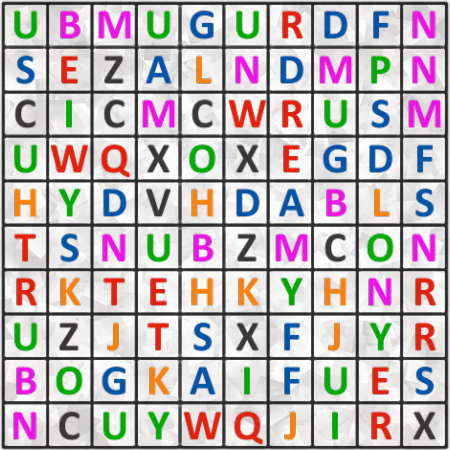
Find a famous person
[5921] Find a famous person - Find the first and the last name of a famous person. Text may go in all 8 directions. Length of words in solution: 4,8. - #brainteasers #wordpuzzles - Correct Answers: 23 - The first user who solved this task is Nílton Corrêa De Sousa
BRAIN TEASERS
enter your answer and press button OK

Find a famous person

Find the first and the last name of a famous person. Text may go in all 8 directions. Length of words in solution: 4,8.
Correct answers: 23
The first user who solved this task is Nílton Corrêa De Sousa.
#brainteasers #wordpuzzles
Register with your Google Account and start collecting points.
Check your ranking on list.

Earning His Stripes

A young reporter went to a retirement home to interview an aged but legendary explorer. The reporter asked the old man to tell him the most frightening experience he had ever had. The old explorer looked into the distance and warmed to his task.

“Once, I was hunting Bengal tigers in the jungles of India,” he began: “I was on a narrow path and my faithful native gun bearer was behind me. Suddenly, the largest tiger I've ever seen in my life leaped onto the path in front of us. I turned to get my weapon only to find my gun bearer had fled. The tiger leaped toward me with a mighty ROARRRR! I soiled myself."

“Under those circumstances, sir, I think anyone would have done the same," the reporter said.

The old explorer replied: "No, not then -– just now when I went 'ROARRRR!'”

Jokes of the day - Daily updated jokes. New jokes every day.
Follow Brain Teasers on social networks

Brain Teasers

puzzles, riddles, mathematical problems, mastermind, cinemania...

Classification of geological eras

In 1759, Italian geologist Giovanni Arduino (1714-1795) dated a letter to Professor A.Vallisneri the younger, in which Arduino proposed a classification of Earth's surface rocks according to four brackets of successively younger orders: Primary, Secondary, Tertiary and Quaternary. These are the four geological eras used today. The volcanic rocks without fossils which he saw in the Atesine Alps that formed the cores of large mountains he called Primary. Overlying them, the fossil rich rocks of limestone and clay that were found on the prealpine flanks of the mountains he called Secondary. The less consolidated fossil-bearing rocks of the subalpine foothills, he named Tertiary, and the alluvial rock deposits in the plains were the Quaternary.«
This site uses cookies to store information on your computer. Some are essential to help the site properly. Others give us insight into how the site is used and help us to optimize the user experience. See our privacy policy.