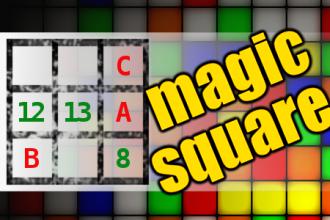
MAGIC SQUARE: Calculate A+B-C
[5922] MAGIC SQUARE: Calculate A+B-C - The aim is to place the some numbers from the list (1, 6, 8, 11, 12, 13, 17, 20, 22, 26, 96) into the empty squares and squares marked with A, B an C. Sum of each row and column should be equal. All the numbers of the magic square must be different. Find values for A, B, and C. Solution is A+B-C. - #brainteasers #math #magicsquare - Correct Answers: 13 - The first user who solved this task is Nílton Corrêa De Sousa
BRAIN TEASERS
enter your answer and press button OK

MAGIC SQUARE: Calculate A+B-C

The aim is to place the some numbers from the list (1, 6, 8, 11, 12, 13, 17, 20, 22, 26, 96) into the empty squares and squares marked with A, B an C. Sum of each row and column should be equal. All the numbers of the magic square must be different. Find values for A, B, and C. Solution is A+B-C.
Correct answers: 13
The first user who solved this task is Nílton Corrêa De Sousa.
#brainteasers #math #magicsquare
Register with your Google Account and start collecting points.
Check your ranking on list.

Two friends were standing in a...

Two friends were standing in a bank when a pair of robbers entered. Not only did the thieves clean out the tills, but they walked around with bags and ordered everyone to throw their valuables in.
Just as the robbers got to the pair, one of the friends turned to the other and, passing him a bill, said, "By the way, Joe, here's that twenty bucks I owe you."
Jokes of the day - Daily updated jokes. New jokes every day.
Follow Brain Teasers on social networks

Brain Teasers

puzzles, riddles, mathematical problems, mastermind, cinemania...

Luddites trial

In 1813, a special Commission opened at York, England to put on trial 66 persons for offenses connected with Luddism. Within days, seventeen of them had been executed on the scaffold. Taking their name from (perhaps mythical) Ned Ludd, Luddites vowed to destroy the factory mechanization they blamed for their unemployment. Riots began in 1812, and spread north from Nottingham where half of the population were receiving parish relief. Falling prices for goods, bad harvest increasing prices for food, wages at starvation level, costs of war and lost foreign markets contributed to the economic distress of the working class. One thousand looms were broken up in Nottingham, and a law was passed making destruction of machinery a capital offence.«
This site uses cookies to store information on your computer. Some are essential to help the site properly. Others give us insight into how the site is used and help us to optimize the user experience. See our privacy policy.