Find a famous person
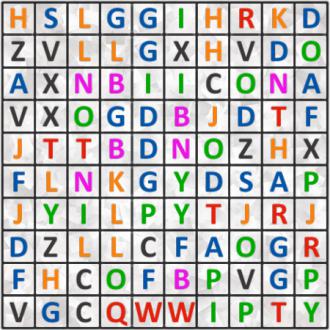
[6480] Find a famous person - Find the first and the last name of a famous person. Text may go in all 8 directions. Length of words in solution: 4,7. - #brainteasers #wordpuzzles - Correct Answers: 16 - The first user who solved this task is Fazil Hashim
BRAIN TEASERS
enter your answer and press button OK

Find a famous person

Find the first and the last name of a famous person. Text may go in all 8 directions. Length of words in solution: 4,7.
Correct answers: 16
The first user who solved this task is Fazil Hashim.
#brainteasers #wordpuzzles
Register with your Google Account and start collecting points.
Check your ranking on list.

A man is out shopping and disc...

A man is out shopping and discovers a new brand of Olympic condoms. Clearly impressed, he buys a pack. Upon getting home he announces to his wife the purchase he just made.
"Olympic condoms?" she blurts. "What makes them so special?"
"There are three colors", he replies, "Gold, Silver and Bronze."
"What color are you going to wear tonight?" she asks cheekily.
"Gold of course," says the man proudly.
The wife responds, "Really? Why don't you wear Silver? It would be nice if you came second for a change."
Jokes of the day - Daily updated jokes. New jokes every day.
Follow Brain Teasers on social networks

Brain Teasers

puzzles, riddles, mathematical problems, mastermind, cinemania...

Thomas S. Kuhn

Born 18 Jul 1922; died 17 Jun 1996 at age 73. Thomas Samuel Kuhn was an American science historian and science philosopher was a MIT professor, noted for his highly influential The Structure of Scientific Revolutions (1962). He held that science was not a steady, cumulative acquisition of knowledge, but it is “a series of peaceful interludes punctuated by intellectually violent revolutions.” Then appears a Lavoisier or an Einstein, often a young scientist not indoctrinated in the accepted theories, to sweep the old paradigm away. Such revolutions, he said, came only after long periods of tradition-bound normal science. He pointed out that scientific research and thought are defined by “paradigms,”or trusted theories, concepts, methods and experiments. Such paradigms are accepted by scientists, who continue to extend, refine, explain and measure results until they meet an problem that cannot be resolved within the established framework. Such anomaly or contradiction eventually requires an intellectual revolution, such as the paradigm shifts from Ptolemaic cosmology to Copernican heliocentrism. “Frameworks must be lived with and explored before they can be broken.”
This site uses cookies to store information on your computer. Some are essential to help the site properly. Others give us insight into how the site is used and help us to optimize the user experience. See our privacy policy.